Rome’s centrality to Christian pilgrimage rests on an irony: none of the Gospels connect Jesus to the eternal city. He never visited. His ministry played out in the towns and countryside of Galilee and Judea, with Jerusalem as the dramatic culmination. The city on the Tiber entered the Christian story through what happened after. The missionary journeys of Peter and Paul, their martyrdoms under Nero, and the decision by the early church to build its center on Peter’s tomb — these post-biblical events created one of the world’s great pilgrimage cities. Within three centuries of the crucifixion, the capital of the empire that had executed Jesus became the capital of the religion founded in his name.
This foundation gave the eternal city a different character from Jerusalem. Where Jerusalem’s holiness derives from events in the life of Jesus, this city’s holiness derives from the church that grew in his name. The result is a pilgrimage city whose sacred geography is institutional as much as scriptural. Popes, councils, relics, and basilicas define Rome and the Vatican rather than hillsides and upper rooms. For pilgrims, this means encountering not a landscape frozen in first-century memory but a living tradition that has been building, rebuilding, and reinterpreting itself for two thousand years. Every century has left its mark — from the catacombs of the persecuted church to Bernini’s soaring colonnade in St. Peter’s Square.
The City of Peter and Paul
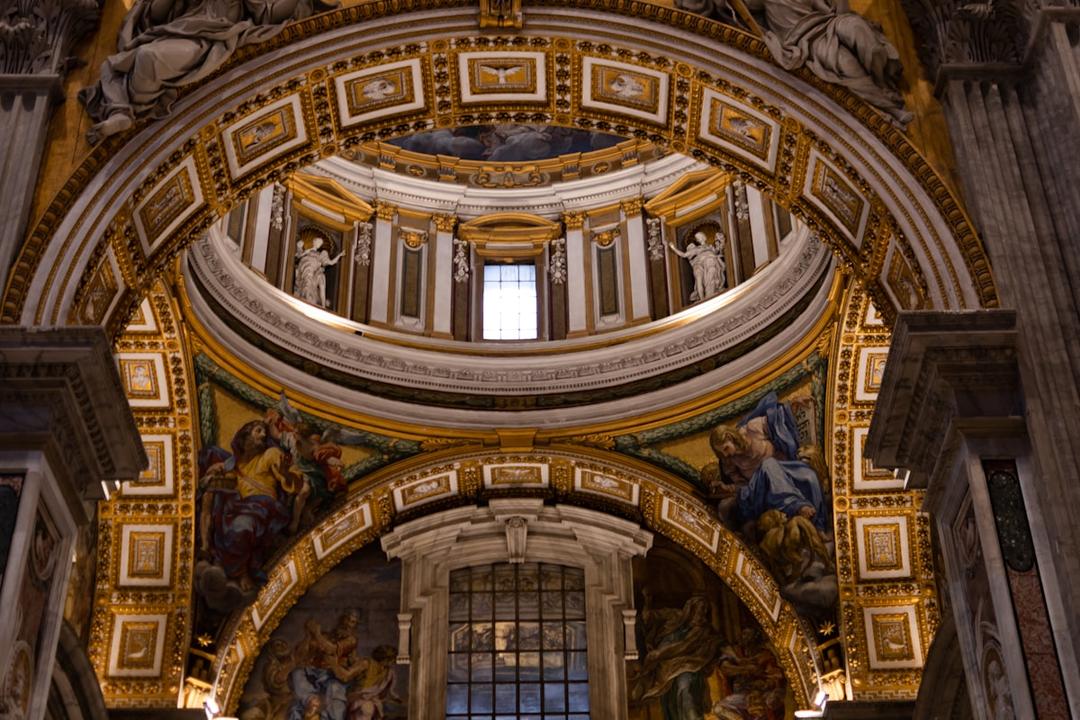
St. Peter’s Basilica is not simply a church but a theological statement rendered in stone and marble. The current Renaissance structure, designed by Bramante, Michelangelo, and Bernini among others, replaced Constantine’s fourth-century basilica. That earlier church was itself built directly over the first-century tomb identified as Peter’s. Archaeological excavations beneath the basilica in the 1940s confirmed the presence of a first-century burial site. This finding lent archaeological weight to the tradition that the first pope was buried here.
The Vatican Museums house one of the world’s great art collections. For pilgrims the Sistine Chapel is the essential destination. Michelangelo’s ceiling and Last Judgment serve as visual theology that communicates across linguistic and cultural barriers. The papal audience, held most Wednesdays when the pope is in Rome, remains one of the world’s most accessible encounters with institutional religious authority. Tens of thousands attend each week in St. Peter’s Square.
Beyond St. Peter’s, the circuit of the seven pilgrimage churches creates a walking pilgrimage within the city. The Basilica of St. Paul Outside the Walls, the Basilica of St. John Lateran, and Santa Maria Maggiore anchor a route that has been practiced since the medieval period. Walking all seven in a single day was a popular devotion during jubilee years and remains a challenge that dedicated pilgrims still undertake. The route covers roughly twenty kilometers and passes through neighborhoods that most tourists never see, offering a view of the city that goes far beyond the Vatican walls.
The Via Francigena: Europe’s Road to Rome
The Via Francigena was medieval Europe’s second great pilgrimage road. It connected Canterbury to Rome along a route of roughly 1,900 kilometers. Sigeric, Archbishop of Canterbury, documented the route in 990 CE during his return from Rome. His account lists seventy-nine stopping points, providing the oldest surviving itinerary. Many of these waypoints still serve modern walkers.
The route passes through France, over the Great St. Bernard Pass in the Alps, and down through Tuscany. Towns along the way — Reims, Lucca, Siena — developed pilgrimage economies that shaped their architecture and identity. Lucca’s cathedral houses the Volto Santo, a wooden crucifix that became a pilgrimage destination in its own right. Siena’s medieval hospice complex testifies to the infrastructure required to support thousands of travelers passing through each year. Even small villages along the route preserve pilgrim hostels and wayside chapels that speak to the density of traffic these roads once carried.
St. Olav’s Way in Norway, while geographically distant, connected Scandinavian pilgrims to the same network of routes that ultimately led south. This illustrates how the city functioned as a continental magnet for medieval devotion. Roads from every direction converged here — the phrase “all roads lead to Rome” had literal truth for medieval pilgrims. Today the Via Francigena is experiencing a revival. Thousands of walkers complete all or part of it each year, drawn by the same combination of physical challenge and spiritual purpose that motivated their medieval predecessors. The route offers a slower, more contemplative approach to the eternal city than any airport arrival can provide.
Relics and the Economy of Devotion
Rome became Christendom’s greatest repository of relics and sacred objects through a combination of martyrdom, imperial patronage, and systematic collection. The city claims to possess fragments of the True Cross, the chains that bound Peter in prison, the table of the Last Supper, and the pillar of the flagellation. The Scala Santa — the staircase Jesus is believed to have climbed during his trial before Pilate — draws pilgrims who ascend its twenty-eight marble steps on their knees. This practice has continued for centuries.
The history of Christian pilgrimage cannot be separated from the history of relic veneration. The eternal city sits at the center of both traditions. The medieval relic trade — the buying, selling, stealing, and forging of sacred objects — was driven partly by devotion and partly by economics. Relics drew pilgrims, and pilgrims brought revenue. Churches across the city competed for the most impressive collections. This sacred economy funded some of the Western world’s greatest architecture and art, from gilded reliquaries to the basilicas that housed them.
The Basilica of the Holy Cross in Jerusalem, despite its name, stands not in the Holy Land but on the outskirts of the eternal city. Helena reportedly filled its foundations with soil from Calvary and deposited relics of the Passion there. The church houses what tradition identifies as fragments of the True Cross, a nail from the crucifixion, and thorns from the crown. The result is a city where artistic masterpieces and sacred objects overlap at almost every turn. A visitor cannot separate the aesthetic from the devotional — and that fusion is precisely the point.
Medieval Pilgrims in Rome
Margery Kempe, the fifteenth-century English mystic, traveled to the eternal city as part of a pilgrimage circuit that also included Jerusalem and Santiago de Compostela. Her account describes the practical challenges of medieval travel. She faced language barriers, unreliable companions, and disputes with fellow pilgrims. She also experienced moments of intense spiritual vision. Her pilgrimage was not a solitary quest but a social experience embedded in the infrastructure of medieval travel. Margery’s account is invaluable precisely because it captures the mundane alongside the mystical — the cost of lodging, the taste of unfamiliar food, the exhaustion of weeks on the road.
Helena, mother of Constantine, is the foundational figure connecting the eternal city to Jerusalem’s pilgrimage geography. Her journey to the Holy Land and her identification of the True Cross established the pattern of imperial pilgrimage that shaped Christian sacred geography for centuries. The relics she brought back became the nucleus of the city’s sacred collections. Her example inspired generations of royal and aristocratic pilgrims who followed in her footsteps, combining personal devotion with political display in a pattern that persisted throughout the medieval period.
Jubilee years, instituted by Pope Boniface VIII in 1300, created periodic surges in pilgrimage traffic. The 1300 jubilee drew an estimated two million pilgrims and could double or triple the population. The tradition continues. The most recent Holy Year in 2025 drew millions to the city. Jubilees demonstrate that the medieval pilgrimage impulse has not diminished. What has changed is the speed of travel — pilgrims who once spent months on the road now arrive by plane in hours, but the experience of entering St. Peter’s Square for the first time retains a power that transcends the mode of transportation.
The Vatican Today
Modern pilgrimage to Rome and the Vatican blends devotion with tourism in ways that illustrate the broader evolution of pilgrimage in the modern era. The Vatican Museums receive over six million visitors annually. Most are tourists rather than pilgrims. Yet the experience of standing in the Sistine Chapel produces moments of awe that blur the distinction between cultural tourism and spiritual encounter. The sheer scale of the collection — over seventy thousand works spanning two millennia — means that even a half-day visit can only scratch the surface.
The catacombs beneath the city offer an encounter with early Christianity that no textbook can replicate. Walking through corridors carved by the first generations of Christians, pilgrims see the earliest art and symbols of the faith. Fish, anchors, the Chi-Rho monogram — these images predate the grand mosaics of the basilicas by centuries. The catacombs of San Callisto and San Sebastiano are the most visited, but over sixty catacomb complexes exist beneath the streets. They remind visitors that the tradition began not in marble palaces but in underground passages carved by communities who worshipped in secret.
The city’s pilgrimage infrastructure has evolved to accommodate modern visitors while preserving ancient traditions. The Vatican’s online reservation system, multilingual audio guides, and crowd management systems coexist with liturgical practices unchanged since the medieval period. The Wednesday papal audience still draws tens of thousands to St. Peter’s Square from every continent.
Beyond Rome: Lourdes and the European Network
Lourdes emerged as a pilgrimage destination in 1858 after Bernadette Soubirous reported visions of the Virgin Mary. The site exists within the Vatican’s ecclesiastical orbit. The visions required investigation and papal validation before official recognition. This process illustrates how the eternal city functions as the authoritative center even for pilgrimage sites hundreds of kilometers away. Every Marian apparition site in the Catholic world — Fatima, Guadalupe, Knock, Medjugorje — traces its legitimacy through a chain of authority that leads back to the Vatican. Without official papal recognition, a reported vision remains merely a local phenomenon rather than a universal pilgrimage destination.
Today Lourdes draws roughly six million visitors annually. Its healing waters, torchlight processions, and ministry to the sick give it a pastoral character distinct from the Vatican’s monumental grandeur. Yet both operate within the same institutional framework of Catholic pilgrimage that traces its authority back to Peter’s tomb. Lourdes completes a European pilgrimage triangle — the Vatican, Santiago, Lourdes — that draws millions of Catholic pilgrims each year.
The eternal city shares its role as a pilgrimage capital with Jerusalem, where the events that Christianity commemorates actually occurred, and with Varanasi, which holds a similar foundational position for Hinduism. But the Vatican’s unique contribution is institutional. It is the place where Christianity became an organized religion, and that organizational power continues to shape pilgrimage across the globe.
Experiences and Tours
The sacred sites here reward guided exploration. The Vatican alone could occupy a week of focused visits. Private guides can navigate the museums’ vast collections to focus on the art and architecture most relevant to pilgrimage history. They can provide access to areas not open to general visitors and explain the theological significance behind artistic choices that casual tourists might overlook.
The combination of ancient sacred sites and modern city infrastructure makes this destination unusually accessible. Unlike remote pilgrimage sites that require physical endurance, the holy places here can be reached by metro, bus, or a short walk from any central hotel. This accessibility makes it ideal for pilgrims of all ages and physical abilities. Whether exploring the catacombs, attending a papal audience, or walking the seven-church circuit, visitors find a pilgrimage tradition that meets them where they are.
St. Peter’s Basilica Guided Tour — From $36 · ★ 5.0 (11 reviews) · Skip the line
Vatican Museums and Sistine Chapel Private Tour — From $445 · ★ 5.0 (5 reviews) · Private
Exclusive Private Tour of the Vatican Museums — From $721 · ★ 5.0 (6 reviews) · Private
Full Day Private Guided Tour of Rome — From $1,642 · ★ 5.0 (80 reviews) · Private · Free cancellation