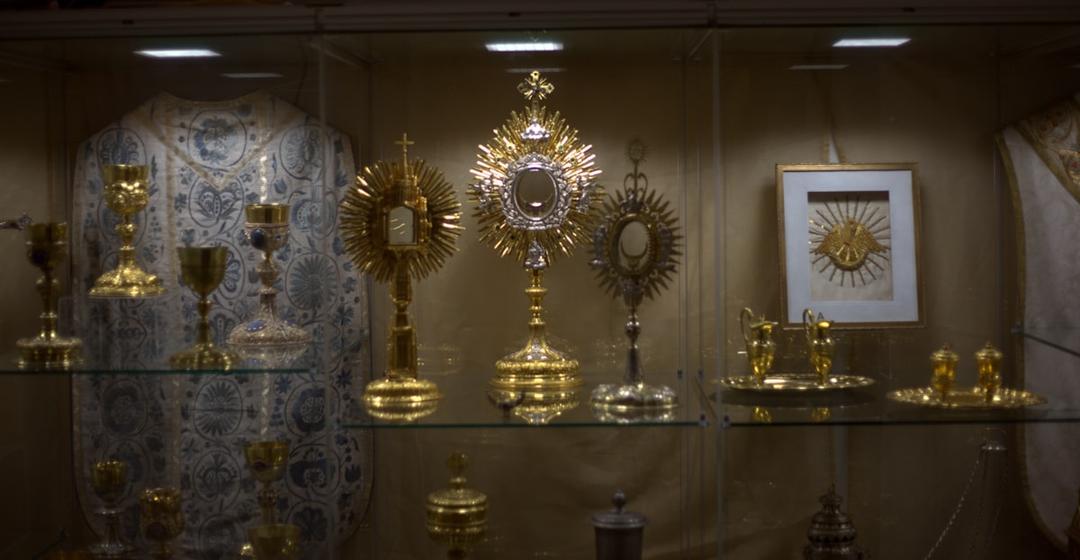
Photo by Andrew V on Unsplash
Relics and Sacred Objects: Pilgrimage History & Context
cultural overview
The role of physical objects — bones, clothing, artifacts, and natural features — in the practice and motivation of pilgrimage across religious traditions.
Related traditions: Christianity, Buddhism, Islam
Regions covered: Europe, Middle East, South Asia, East Asia
The Paradox of Sacred Materiality
Pilgrimage traditions across the world’s religions share a common feature that is, on reflection, deeply puzzling: the attribution of extraordinary significance to ordinary physical objects. A fragment of bone, a piece of wood, a tooth, a garment, a stone bearing a footprint — objects that in themselves possess no obvious power — become, within religious frameworks, channels of sacred presence capable of healing the sick, answering prayers, and justifying journeys of thousands of kilometers. The phenomenon of relic veneration raises fundamental questions about the relationship between the material and the spiritual, between the physical world and whatever transcendent reality a given tradition posits.
The theological justifications for relic veneration differ across traditions, but they share a common logic: the sacred, having once been present in or near a physical object, leaves a residue of that presence that the object retains and that the faithful can access through proximity, touch, or devotion. This logic operates whether the tradition frames the sacred as God (Christianity, Islam), as enlightenment (Buddhism), or as divine presence (Hinduism). The specific object becomes a point of contact between the human and the transcendent — a bridge that allows the pilgrim to cross, however briefly, the gap between ordinary experience and sacred encounter.
Christian Relics
The Christian relic tradition, among the most elaborate in world religion, distinguishes three classes of relics. First-class relics are physical remains of saints — bones, blood, hair, or preserved bodies. Second-class relics are objects that saints owned, used, or wore. Third-class relics are objects that have been touched to first-class relics, acquiring holiness through contact. This classification system reflects a theology of holiness as transmissible — a quality that flows from person to object, and from object to object, through physical contact.
The most celebrated Christian relic tradition surrounds the True Cross, discovered according to tradition by Helena Augusta in Jerusalem in the early fourth century. Fragments of the cross were distributed across Christendom, and churches that possessed them became pilgrimage destinations. By the medieval period, the fragments claimed by various churches were, according to skeptical calculations, sufficient to build several ships — an observation that critics from the Reformation onward have cited as evidence of fraudulent multiplication. Defenders of the tradition respond that the relic’s power is not diminished by division, and that the multiplication of fragments represents divine generosity rather than human deception.
The medieval relic trade generated both economic activity and theological controversy. The translation (transfer) of relics between churches was sometimes accomplished through legitimate purchase or gift, sometimes through theft (known as furta sacra, “holy theft,” a category that reveals the moral complexity of relic acquisition), and sometimes through outright fabrication. The Fourth Lateran Council of 1215 attempted to regulate the relic trade by requiring papal authentication of new relics, but the economic incentives created by relic-driven pilgrimage ensured that abuses continued.
Buddhist Relics
The Buddhist relic tradition originates with the distribution of the Buddha’s cremation remains among eight claimant groups, as described in the Mahaparinibbana Sutta. These relics were enshrined in stupas — dome-shaped monuments that became the architectural foundation of Buddhist sacred space. Emperor Ashoka is said to have redistributed the original relics across 84,000 stupas throughout his empire, democratizing access to the Buddha’s physical remains and establishing a pattern of stupa veneration that spread with Buddhism across Asia.
The most celebrated Buddhist relic is the tooth of the Buddha, enshrined in the Temple of the Sacred Tooth Relic in Kandy, Sri Lanka. The tooth has been a source of political legitimacy as well as religious devotion — possession of the relic was historically considered essential to the sovereignty of Sinhalese kings, and the annual Esala Perahera festival, featuring a procession of the relic through the streets of Kandy, remains one of the most spectacular religious events in South Asia.
Buddhist relic veneration extends beyond the Buddha’s remains to include relics of other enlightened beings and objects associated with the Buddha’s life. Bodhi tree cuttings — descendants of the tree under which the Buddha attained enlightenment — have been transported across the Buddhist world, and temples housing such cuttings become pilgrimage destinations in their own right. The footprint of the Buddha, preserved at sites from Sri Lanka to Thailand to China, provides another category of relic that generates pilgrimage.
Islamic Sacred Objects
Islam’s relationship to sacred objects is more complex and contested than that of Christianity or Buddhism. The tradition’s strong emphasis on tawhid (the oneness of God) and its prohibition of shirk (associating anything with God) creates a theological framework that is, in principle, hostile to the veneration of physical objects. Yet in practice, several objects and sites within Islam function in ways that parallel relic veneration in other traditions.
The Black Stone (al-Hajar al-Aswad), set into the eastern corner of the Kaaba, is the most prominent sacred object in Islam. Tradition holds that the stone was given to Ibrahim by the angel Gabriel, and that it was originally white but has been blackened by absorbing the sins of those who touch it. Pilgrims performing Tawaf attempt to kiss or touch the Black Stone, following the example of the Prophet Muhammad, who reportedly said: “I know that you are a stone and can neither benefit nor harm. Had I not seen the Prophet kiss you, I would not kiss you.”
The Prophet’s tomb in Medina, while not technically a relic site in the Christian sense, functions as a pilgrimage destination where the faithful seek proximity to the Prophet’s physical remains. The theological debates surrounding the practices associated with the tomb — whether visiting it constitutes a meritorious act or a form of forbidden saint-worship — reflect the ongoing tension within Islam between devotional practice and strict monotheistic theology.
The Critique of Relics
Every tradition that practices relic veneration has generated internal critics who question or condemn the practice. The Protestant Reformation mounted the most systematic critique within Christianity, with reformers like John Calvin arguing that relic veneration constituted idolatry — the worship of created objects rather than the Creator. Calvin’s Treatise on Relics (1543) cataloged the absurdities of the relic system with devastating wit, noting that multiple churches claimed to possess the same unique object and that the volume of relics attributed to individual saints exceeded what any single body could have produced.
Within Islam, the Wahhabi movement that emerged in eighteenth-century Arabia condemned the veneration of tombs and sacred objects as innovations (bid’ah) that corrupted the pure monotheism of early Islam. The destruction of numerous shrines and tombs in territories under Wahhabi influence represented a physical enactment of this theological critique. Within Buddhism, certain Zen traditions have emphasized that attachment to relics contradicts the fundamental teaching of non-attachment, though even these traditions have rarely eliminated relic veneration entirely.
The scholarly study of relics, pioneered by historians like Peter Brown and Patrick Geary, has moved beyond the question of authenticity (which occupied earlier generations of both defenders and critics) to examine the social, economic, and psychological functions that relics serve. Relics create focal points for community identity, generate economic activity through pilgrimage, provide tangible evidence of the sacred that makes abstract theology accessible, and offer individuals a sense of personal connection to the figures and events of sacred history.
Translation — The formal transfer of a relic from one location to another, often accompanied by elaborate ceremony. In medieval Christianity, the translation of relics was a major event that could transform a church’s status and generate new pilgrimage flows.
Stupa/Chorten/Pagoda — Architectural forms developed across Buddhist cultures to enshrine relics. The basic dome shape of the Indian stupa was adapted into the chorten of Tibetan Buddhism, the dagoba of Sri Lankan Buddhism, and the pagoda of East Asian Buddhism, each preserving the fundamental function of relic containment within culturally specific architectural traditions.
Contact Relic — An object that acquires sacred significance through physical contact with a primary relic or sacred person. The concept operates across traditions: a cloth touched to a saint’s tomb, a prayer bead rubbed against a stupa, a pilgrim’s garment worn at a sacred site — all become carriers of holiness through the logic of contact.
Incorruptibility — The preservation of a saint’s body from decay, regarded in Catholic tradition as evidence of sanctity. Incorrupt bodies — or bodies that have resisted normal decomposition — are displayed in churches across Europe, their preserved state serving as a visible argument for the reality of holiness.
Peter Brown’s The Cult of the Saints (1981) remains the foundational scholarly treatment of Christian relic veneration. Patrick Geary’s Furta Sacra (1978) examines the practice of relic theft. John S. Strong’s Relics of the Buddha (2004) provides the most comprehensive treatment of Buddhist relic traditions. For Islamic sacred objects, Josef Meri’s The Cult of Saints among Muslims and Jews in Medieval Syria (2002) examines the shared and contested practices of relic veneration in the Middle East.
- Helena and the True Cross — The discovery that launched Christianity’s relic tradition
- Lourdes — A modern pilgrimage site centered on water rather than relics
- Christian Pilgrimage Traditions — The tradition most shaped by relic veneration
- Four Sacred Sites of Buddhism — Sites connected to the original distribution of the Buddha’s relics