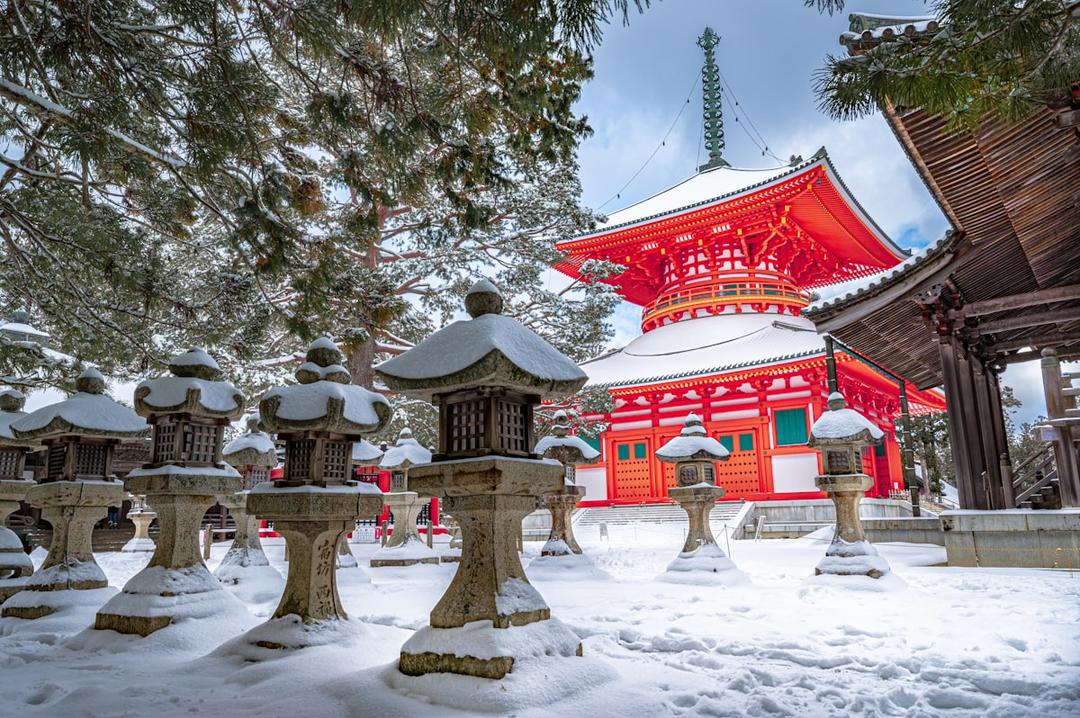
Japan’s sacred geography operates on principles foreign to the Western pilgrimage traditions. Where Christianity and Islam center on specific historical events — a crucifixion, a revelation — Japanese pilgrimage weaves together Buddhist philosophy, Shinto nature worship, and a landscape theology in which mountains, forests, and rivers are themselves divine. The kami, spirits that inhabit natural features, make every waterfall, ancient tree, and mountain peak a potential site of encounter with the sacred. Kyoto served as Japan’s capital for over a millennium. The city and the region surrounding it became the heartland of this pilgrimage culture. Today three of Asia’s most important pilgrimage circuits radiate from this corner of Japan, each offering a distinct approach to sacred walking.
This fusion of Buddhist and Shinto traditions produces a pilgrimage culture unlike anything in the Abrahamic faiths. Pilgrims walk not to reach a single holy destination but to move through a sacred landscape. They accumulate merit and insight with each step. The journey itself — not the arrival — carries the deepest spiritual significance. This makes Japan’s pilgrimages fundamentally different from the goal-oriented journeys of Christian pilgrimage or the Islamic Hajj, where reaching a specific site is the point. Here the path is the point. The walking is not preparation for the sacred. The walking is the sacred act itself.
Mount Kōya: The Mountain Monastery
Mount Kōya is the headquarters of Shingon Buddhism, founded by Kōbō Daishi (Kūkai) in 816 CE after he returned from studying esoteric Buddhism in China. Kūkai chose this remote mountaintop deliberately. He sought a place where the physical difficulty of the ascent would itself prepare the mind for spiritual practice. The mountain settlement grew into a temple city of over a hundred monasteries. Many still offer shukubo — overnight temple lodging where guests eat Buddhist vegetarian cuisine, join morning prayers at dawn, and experience monastic life firsthand. The food alone is remarkable: multi-course kaiseki meals prepared without meat, fish, or pungent vegetables, following rules established over a thousand years ago.
The Okunoin cemetery, stretching for two kilometers beneath towering cedars, is the spiritual heart of Kōya-san. Over 200,000 memorial stones line the path to Kōbō Daishi’s mausoleum. The founder is believed to rest there in eternal meditation, awaiting the coming of the future Buddha Maitreya. Monks deliver meals to his tomb daily, maintaining the faith that he is not dead but merely waiting. Walking through Okunoin at dawn — surrounded by mossy tombstones, the scent of incense, and the sound of chanting — produces an encounter with impermanence. This is the philosophical core of Japanese Buddhist practice. The experience stays with visitors long after they descend the mountain. At night, lantern-lit walks through the cemetery transform the space entirely. Shadows move between the stone markers and the ancient trees seem to breathe.
The Kumano Kodō: Where Gods Walk in the Forest
The Kumano Kodō trails form a network of ancient pilgrimage routes through the mountains of the Kii Peninsula. They lead to the three Grand Shrines of Kumano. Unlike the Camino de Santiago’s single-path model, the Kumano Kodō offers multiple routes that converge from different directions. The Nakahechi, Kohechi, Ohechi, and Iseji each have their own character and difficulty level. This structure gives pilgrims a choice that reflects their physical ability and spiritual intention.
The trails hold dual UNESCO World Heritage status. They are one of only two pilgrimage routes in the world to hold this distinction, alongside the Camino. This recognition reflects both their historical significance and their remarkable preservation. Sections of the Nakahechi route still pass through primeval forest on stone-paved paths laid centuries ago. The physical landscape has barely changed since the Heian period. Walking these paths, you encounter the same moss-covered stones, the same play of light through cedar canopy, that pilgrims experienced a thousand years ago. Small tea houses and wayside shrines mark the trail at regular intervals. Some have offered rest to travelers since the twelfth century. The sense of walking in others’ footsteps is not abstract here — it is literal, physical, and profoundly moving.
The Kumano shrines themselves represent a synthesis of Buddhist and Shinto traditions that is characteristically Japanese. The principal deities are understood through both frameworks simultaneously — Shinto kami who are also Buddhist bodhisattvas. This theological flexibility would be heresy in the Abrahamic traditions but is entirely natural in Japan’s religious landscape. For visitors from Jerusalem or Rome, where traditions compete for the same sacred ground, this peaceful coexistence is striking.
The Shikoku 88 Temples: Walking with Kōbō Daishi
The Shikoku 88 Temple Pilgrimage is a 1,200-kilometer circuit around Japan’s smallest main island. It visits eighty-eight temples associated with Kōbō Daishi. Pilgrims — called henro — walk in white robes, carrying staffs inscribed with the words “two traveling together.” This signifies that Kōbō Daishi walks beside every pilgrim on the path.
The circuit takes thirty to sixty days on foot. It is one of the few circular pilgrimages in the world. There is no fixed starting point, no single destination — only the continuous act of walking. This structure reflects a Buddhist understanding of spiritual development that is cyclical rather than linear. Enlightenment is not a place you arrive at but a quality of attention you develop through sustained practice. The circular form also means that completion is not really completion. Many henro walk the circuit multiple times, finding different insights with each round.
The culture of osettai — hospitality offered to henro by local residents — remains strong. Villagers along the route provide tea, food, and sometimes lodging to passing pilgrims. They consider the act of giving to be its own form of merit-making. This reciprocal economy of spiritual generosity has no direct equivalent in Western pilgrimage traditions, though the albergue system along the Camino de Santiago comes closest. The white-robed henro are a familiar sight in rural Shikoku. Local people greet them with respect and encouragement. For the communities along the route, supporting pilgrims is a living tradition that connects them to centuries of practice. The relationship between walker and village is itself a form of pilgrimage — a mutual exchange of care that benefits both sides.
The Psychology of Japanese Pilgrimage
The psychology of pilgrimage — the way sustained walking changes consciousness — finds perhaps its purest expression in the meditative rhythms of Japanese trail pilgrimage. The repetitive physical motion, the focus on each step, the gradual dissolution of mental chatter into a quieter awareness: these are not side effects of the journey but its purpose. Japanese pilgrimage is, at its core, a walking meditation.
Research on Shikoku henro and Kumano Kodō walkers suggests that the psychological benefits of Japanese pilgrimage are distinct from Western equivalents. Where Camino walkers often report a sense of purpose or direction gained through the journey, Japanese pilgrims more commonly describe a letting-go. They speak of a release of attachment to outcomes that aligns with Buddhist teachings on impermanence and non-self. The Japanese concept of musubi — a tying together of the human and divine — suggests that pilgrimage is less about individual transformation than about restoring a connection that was always present but had been forgotten.
The physical demands reinforce this process. Steep mountain trails force attention into the body. Rain, heat, and fatigue strip away mental distractions. By the second week of walking, many henro report that the boundary between self and landscape begins to dissolve. This is not metaphor but lived experience — a psychological shift documented by researchers studying long-distance walkers across cultures.
This contemplative dimension connects Japanese pilgrimage to the broader Buddhist pilgrimage tradition. The practices differ dramatically from the Indian origins, but the underlying insight is shared: walking with attention is itself a form of awakening.
The Wider Buddhist Pilgrimage World
Japan’s pilgrimages connect to a broader tradition of Buddhist sacred sites across Asia. The four great pilgrimage sites in India — Bodh Gaya, Lumbini, Sarnath, and Kushinagar — mark the key events of the Buddha’s life. They predate Japanese Buddhism by more than a millennium. Japanese pilgrims have traveled to these Indian sites for centuries, and the connection between Varanasi’s Buddhist geography and Japan’s adapted traditions traces a line of transmission across two thousand years and thousands of kilometers. The Indian origins gave Japanese Buddhism its core philosophical and ethical framework. Japan gave it a distinctive aesthetic and a deep integration with the natural landscape that has no parallel in South Asian practice.
Xuanzang, the seventh-century Chinese monk who spent sixteen years traveling to India and back to collect Buddhist scriptures, became one of the most celebrated figures in East Asian Buddhism. His account of the Indian pilgrimage sites influenced Japanese Buddhist travelers for centuries. He established the template for scholarly pilgrimage that Japan’s monastic traditions adapted to their own landscape. The texts he brought back to China were translated into Japanese and became foundational for the Shingon and other schools that would later create Japan’s great pilgrimage circuits. His journey inspired the classical Chinese novel “Journey to the West,” ensuring his story reached audiences far beyond the monastery walls. Xuanzang’s legacy illustrates how pilgrimage traditions cross borders. Indian Buddhism traveled to China through scholarly pilgrims, then to Japan, where it merged with Shinto to produce something entirely new.
Experiencing Sacred Japan Today
Japan’s pilgrimage infrastructure makes these ancient routes remarkably accessible to modern travelers. Temple lodging on Mount Kōya provides an immersive overnight experience that requires no prior Buddhist knowledge. The Kumano Kodō offers well-marked trails with luggage forwarding services and comfortable ryokan at each stage. Even the Shikoku circuit, the most demanding of the three, has developed a network of accommodation and support services for walking pilgrims.
The best seasons for Japanese pilgrimage are spring (late March through May) and autumn (October through November). Mild temperatures and seasonal beauty — cherry blossoms or autumn foliage — enhance the walking experience. Summer brings heat and humidity that make long-distance walking difficult. Winter snow closes some mountain passes but adds a stark beauty to Okunoin cemetery.
Kyoto itself serves as the natural gateway to all three pilgrimage circuits. The city’s thousand-plus temples, its traditional ryokan inns, and its deep aesthetic culture provide context for the pilgrimage experiences that radiate outward into the surrounding mountains and coastline. A week based in Kyoto allows day trips to nearby sacred sites. The longer circuits — Shikoku and the full Kumano Kodō — require dedicated multi-week commitments. They reward the investment many times over. First-time visitors often begin with a few days on the Kumano Kodō’s Nakahechi route, the most accessible and best-supported of Japan’s pilgrimage trails, before deciding whether to return for the deeper commitment of Shikoku’s full circuit. Our practical planning guide covers JR passes, temple lodging bookings, and cultural etiquette. The 7-day sacred Japan itinerary takes you from Kyoto temples to Kōya-san monastery to a three-day Kumano Kodō trek through ancient forests.
Experiences and Tours
Guided experiences in Kyoto and the surrounding region open doors to traditions that can be difficult for visitors to access independently. Temple ceremonies, tea rituals, and forest trail walks all benefit from local guides who can explain the cultural and spiritual significance that might otherwise go unnoticed. The region’s sacred sites are spread across mountains and rural valleys. A guide can connect the dots between a Zen garden in Kyoto, a mountaintop monastery on Kōya-san, and a forest trail on the Kumano Kodō.
Even within the city itself, Kyoto’s temple culture runs deep. The tea ceremony, the arrangement of a rock garden, the architecture of a shrine gate — each carries layers of meaning that a knowledgeable guide can unlock. Walking tours through the geisha district of Gion and the temple precincts of Higashiyama reveal a city where the sacred and the aesthetic are inseparable.
Kiyomizu Temple and Backstreets of Gion Walking Tour — From $59 · ★ 5.0 (51 reviews) · Group tour
Private Tea Ceremony and Sake Tasting in Samurai House — From $131 · ★ 5.0 (163 reviews) · Private
Fushimi Inari Shrine Walking Tour — From $39 · ★ 5.0 (74 reviews) · Free cancellation
Hiking Tour: Nature and Legends of Kurama and Kibune — From $190 · ★ 5.0 (77 reviews) · Free cancellation