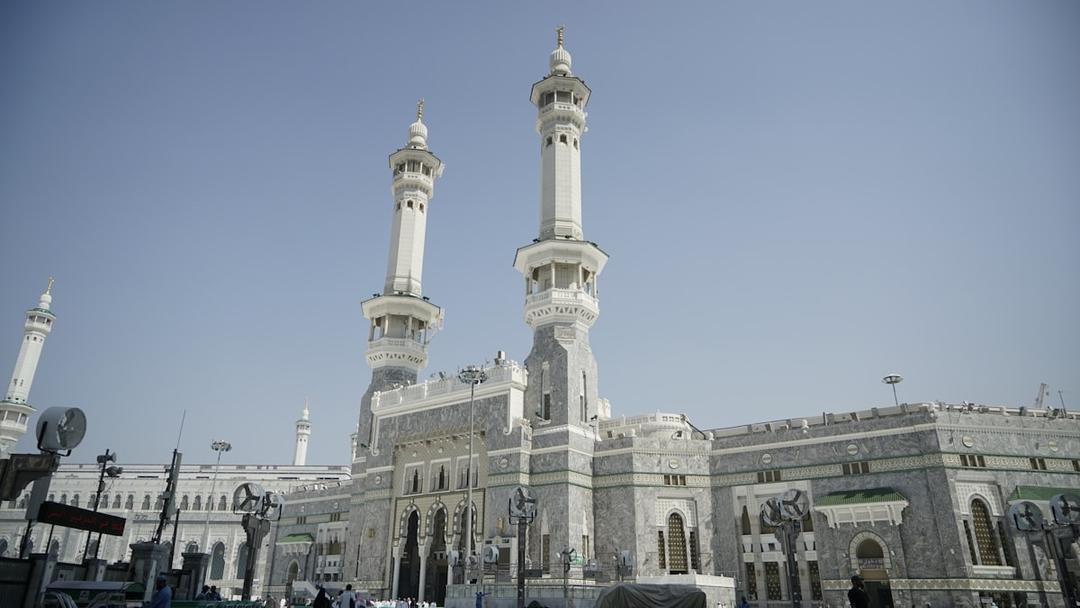
Mecca and Medina together form the axis of Islamic pilgrimage. Every Muslim who is physically and financially able must perform the Hajj at least once in a lifetime. It is the fifth pillar of Islam, a duty so central that it shapes the religious calendar, the architecture of mosques worldwide, and the spiritual aspirations of nearly two billion people.
No other pilgrimage tradition commands such universal obligation. While other faiths encourage pilgrimage, Islam requires it. The result is the largest annual gathering of human beings on earth. Over two million pilgrims converge on a single city during the designated days of Dhul Hijjah. They wear identical white garments that erase all distinctions of wealth, nationality, and social status. This radical equality, enacted through ritual dress, is part of the theological point. Before God, all human beings stand identical. The Hajj makes this abstract principle physically visible on the grandest possible scale. The spectacle of millions dressed in white, circling the same stone structure, chanting the same words in the same language, creates an image of human unity that no other event on earth can match.
Mecca: The Center of the Islamic World
The Kaaba, the cube-shaped structure at the center of Mecca’s Grand Mosque, is believed by Muslims to have been built by Ibrahim (Abraham) and his son Ismail as a house of worship to the one God. The Prophet Muhammad was born in Mecca. He received his first revelations in a cave on nearby Mount Hira. After years of exile in Medina, he returned to cleanse the Kaaba of its pre-Islamic idols.
The Hajj rituals reenact events from the lives of Ibrahim, Hajar (Hagar), and Ismail. Pilgrims circle the Kaaba seven times in tawaf. They walk between the hills of Safa and Marwa as Hajar did while searching for water for her infant son. They stand together on the plain of Arafat in collective supplication. This day of standing at Arafat is considered the spiritual climax of the pilgrimage. Scholars describe it as a rehearsal for the Day of Judgment, when all humanity will stand before God in the same posture of vulnerability.
The Grand Mosque has been expanded repeatedly to accommodate growing numbers. The current structure can hold over two million worshippers at once. It is the largest mosque in the world. The engineering challenges of managing crowd flow, providing water and sanitation, and preventing stampedes have driven innovations studied by urban planners worldwide. The Zamzam well, located within the mosque complex, provides water that pilgrims drink and carry home in bottles. According to tradition, this is the well that God revealed to Hajar as she searched desperately for water in the desert. The continuity between the ancient story and the modern ritual is characteristic of the Hajj. Every act that pilgrims perform today reenacts something that happened here thousands of years ago.
The Umrah: The Lesser Pilgrimage
The Umrah can be performed at any time of year. It shares several of the Hajj’s rituals — tawaf around the Kaaba and sa’i between Safa and Marwa — without the seasonal requirement or the journey to Arafat. Millions perform Umrah annually. The practice has grown significantly with the expansion of airline travel and Saudi visa reforms that now allow electronic visas for citizens of many countries. The relative ease of arranging an Umrah compared to the quota-controlled Hajj means that for many Muslims, the lesser pilgrimage becomes their first direct encounter with the holy city.
Performing Umrah during Ramadan is considered especially meritorious. The Prophet Muhammad is reported to have said that an Umrah in Ramadan is equivalent in reward to a Hajj. This teaching drives a massive surge in pilgrimage traffic during the holy month. The result is a secondary peak season that challenges Saudi infrastructure almost as much as the Hajj itself. For many Muslims who cannot yet afford or arrange the full Hajj, Umrah provides a meaningful first encounter with the holy city. The rituals are briefer but no less intense. Walking through the Grand Mosque for the first time, seeing the Kaaba with one’s own eyes after a lifetime of praying in its direction — this moment overwhelms most pilgrims regardless of which pilgrimage they are performing.
Medina: The City of the Prophet
Medina holds a different kind of holiness. It is not obligatory to visit Medina as part of the Hajj, but the vast majority of pilgrims do. The Prophet’s Mosque, rebuilt and expanded over the centuries from Muhammad’s original modest structure, is the second holiest site in Islam. To pray there is considered worth a thousand prayers elsewhere.
The city’s atmosphere differs from Mecca’s intensity. Where Mecca pulses with the energy of obligatory ritual — the press of bodies in tawaf, the urgency of completing rites within prescribed times — Medina offers a gentler spiritual experience. Pilgrims visit the Prophet’s grave. They pray in the Rawdah, the area between the Prophet’s tomb and his pulpit, considered one of the gardens of paradise. They walk through streets where the first Muslim community took shape. The pace is slower. The mood is contemplative. Many pilgrims describe Medina as the emotional heart of their journey, even though Mecca is the theological center.
The Quba Mosque, on the outskirts of Medina, was the first mosque built in Islam. Muhammad himself laid the first stones during the Hijra. Visiting Quba and praying there carries its own spiritual reward. The mosque functions as a secondary pilgrimage site within Medina’s sacred geography. The route between the Prophet’s Mosque and Quba passes through neighborhoods where the companions of the Prophet lived. For pilgrims with a sense of Islamic history, every street corner in Medina carries echoes of the community that Muhammad built from scratch — a community that within a century would stretch from Spain to Central Asia.
The Broader Geography of Islamic Pilgrimage
Islamic sacred geography extends well beyond the two holy cities through the tradition of ziyarat — visiting shrines, tombs, and holy places. Attitudes toward ziyarat vary significantly between Sunni and Shia traditions. For Shia Muslims, the shrine cities of Najaf and Karbala in Iraq hold a significance that rivals Mecca itself. These cities are the burial places of Imam Ali and Imam Hussein, whose martyrdom at Karbala in 680 CE is the foundational event of Shia identity.
The Arbaeen pilgrimage to Karbala, commemorating the fortieth day after Hussein’s martyrdom, draws an estimated twenty million participants annually. This may be the largest annual gathering of human beings on earth, surpassing even the Hajj. It receives relatively little international media attention but represents one of the most remarkable expressions of devotion in any religious tradition. The sheer scale of Arbaeen — a city-sized encampment of tents, kitchens, and mobile clinics, sustained entirely by volunteer effort — has no parallel anywhere in the world.
Jerusalem also holds deep significance in Islamic pilgrimage. The city served as the first qibla and remains the third holiest site in Islam. Many pilgrims who complete the Hajj extend their journey to include al-Quds, connecting the sacred geography of Arabia to the broader landscape of Islamic devotion. This triangulation of Mecca, Medina, and Jerusalem creates a pilgrimage geography that spans from the Arabian Peninsula to the Levant. For Shia pilgrims, the circuit extends further — to Najaf and Karbala in Iraq, to Mashhad in Iran, to the tombs of Imams and saints across the Islamic world. The result is a global network of sacred sites connected by centuries of continuous pilgrimage traffic.
The Five Pillars and the Hajj’s Place Within Islam
Understanding the Hajj requires understanding its place within the broader structure of Islamic practice. The five pillars — the shahada (declaration of faith), salat (prayer), zakat (charity), sawm (fasting during Ramadan), and Hajj — form a graduated sequence of obligations. The Hajj is the culmination. It is the most demanding pillar, requiring physical ability, financial means, and the willingness to undertake a journey that, for most of Islamic history, involved real danger.
The theological significance extends beyond personal devotion. The gathering of millions from every nation, language, and social class — all wearing the same white ihram garments, performing the same rituals, standing equal before God — enacts the umma, the global Muslim community, in its most visible form. Malcolm X, performing the Hajj in 1964, described the experience as a revelation of human equality that transformed his understanding of race and brotherhood. His letter from Mecca remains one of the most powerful first-person accounts of pilgrimage ever written.
The connection between the Hajj and Ibrahim’s story gives Islamic pilgrimage a direct link to the Abrahamic tradition shared with Judaism and Christianity. Rome builds its pilgrimage identity on Peter and Paul. Jerusalem layers three Abrahamic traditions onto one landscape. Mecca reaches back to the patriarch himself. The rituals of the Hajj do not commemorate the life of Muhammad but the life of Ibrahim. This connection to the oldest of the monotheistic patriarchs gives the Hajj a universalist dimension that transcends the boundaries of any single tradition. Ibrahim belongs to all three faiths. The Hajj enacts his story on a scale that none of the others can match.
Planning a Pilgrimage to Mecca and Medina
The logistics of Hajj and Umrah have changed dramatically in the modern era. Saudi Arabia manages the pilgrimage through a quota system that allocates visas by country. The application process typically begins months in advance through authorized Hajj agencies in the pilgrim’s home country. Costs vary widely depending on the package selected, from basic shared accommodation to premium private tents at Arafat.
Ibn Battuta, the fourteenth-century Moroccan scholar, began his legendary thirty-year journey as a Hajj pilgrim. His account illustrates how the Hajj functioned not merely as a religious obligation but as a gateway to a wider world of learning, trade, and exchange. The pilgrimage routes that connected Muslim communities across three continents created networks that shaped civilizations. Ibn Battuta traveled from Morocco to Mecca, then onward to India, China, and sub-Saharan Africa. His journey began as a pilgrimage and became one of the greatest travel narratives in world literature. Modern air travel has compressed these journeys into hours but has not eliminated the transformative power of arriving in the holy city for the first time.
The pilgrimage experience itself lasts between five and ten days for Hajj, or a few hours to a few days for Umrah. But pilgrims consistently report that the spiritual impact extends far beyond the time spent in the holy cities. The memory of standing at Arafat, of circling the Kaaba in a river of humanity, of praying in the Prophet’s Mosque at dawn — these experiences become reference points for the rest of a pilgrim’s life. Our Hajj and Umrah planning guide covers visas, ihram, and practical preparation. The complete Hajj itinerary walks through each ritual day — Mina, Arafat, Muzdalifah, the stoning, Tawaf, and the Medina extension.
Experiences and Tours
Guided ziyarat tours in Medina provide context and access to the holy sites surrounding the Prophet’s Mosque. Knowledgeable local guides can explain the historical significance of each location and help pilgrims navigate the crowds. For first-time visitors, a guided tour transforms what might be an overwhelming experience into a structured and meaningful journey through Islamic sacred history.
Medina’s historical sites extend beyond the Prophet’s Mosque to include the battlefields of Uhud and Badr, the Quba Mosque, and the mosques of the Qiblatain and the Seven Mosques. Each site connects to a specific moment in the life of the Prophet and the early Muslim community. Walking between them creates a narrative pilgrimage through the founding events of Islam. Many guides are themselves scholars of Islamic history and can provide insights that go far beyond what any guidebook offers. The personal stories they share — of their own pilgrimages, of the pilgrims they have guided — add a human dimension to the historical narrative.
Private Guided Spiritual Ziyarat Tour of Madinah — From $100 · ★ 4.9 (97 reviews) · Private
Half-Day Tour in Prophet Mohammed City — From $149 · ★ 5.0 (7 reviews)
Madinah Ziyarats: Holy Places Visit — From $220 · ★ 5.0 (1 review) · Free cancellation