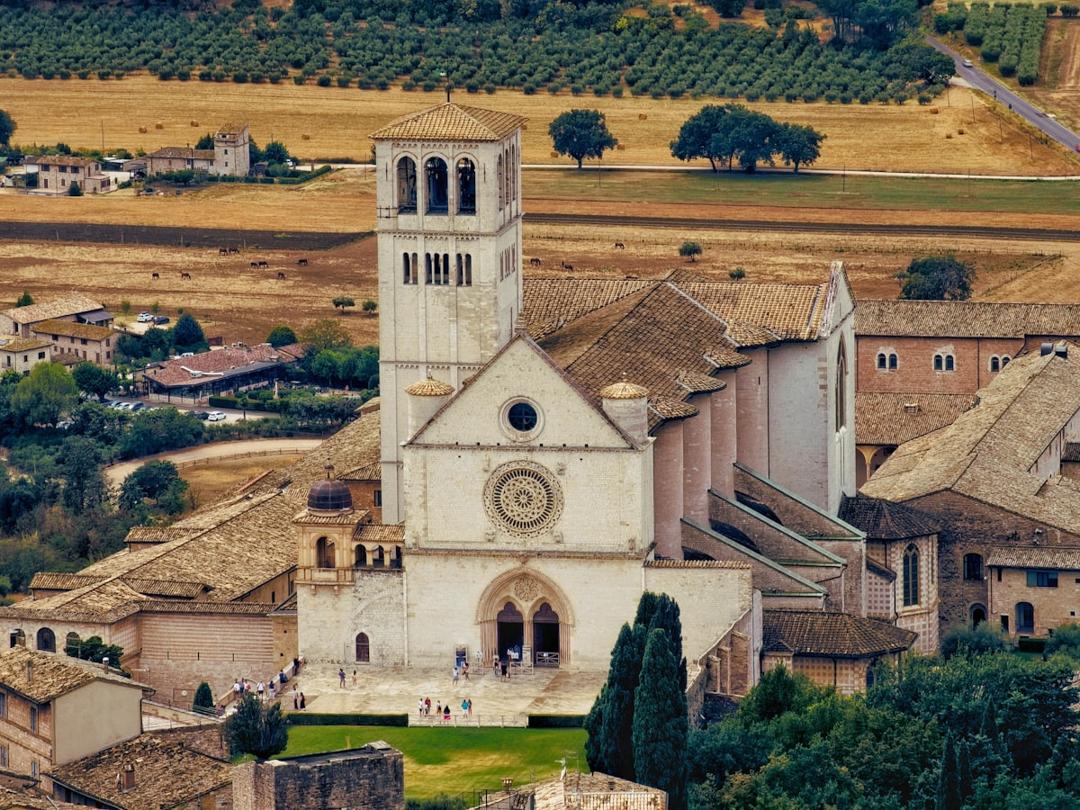
Photo by Gary Walker-Jones on Unsplash
History of Christian Pilgrimage
historical background
An overview of the development of pilgrimage practices within Christian traditions from antiquity to the present. Christian pilgrimage did not emerge in a.
Related traditions: Christianity, Catholicism, Eastern Orthodoxy, Protestantism
Regions covered: Europe, Middle East
Roots in the Ancient World
Christian pilgrimage did not emerge in a vacuum. The practice drew on Jewish traditions of festival pilgrimage to the Jerusalem Temple, prescribed three times yearly in Deuteronomy, and on Greco-Roman customs of visiting oracles, healing shrines, and sites associated with mythological events. The historian E.D. Hunt has documented how early Christians inherited and transformed these existing patterns, creating something recognizable as pilgrimage yet distinct in its theological motivations and its relationship to sacred texts.
The earliest Christians appear not to have practiced pilgrimage in any organized sense. The communities described in Paul’s letters and the Acts of the Apostles focused on the return of Christ rather than on venerating places associated with his earthly life. The destruction of Jerusalem by Roman forces in 70 CE and again after the Bar Kokhba revolt in 135 CE further disrupted any continuity of site veneration. The Roman city of Aelia Capitolina, built over Jerusalem’s ruins, buried many of the locations that would later attract pilgrims.
The Constantinian Transformation
The legalization of Christianity under Constantine in 313 CE and his subsequent patronage fundamentally altered the conditions for pilgrimage. Constantine’s mother Helena traveled to the Holy Land around 326-328 CE, and the building program she and Constantine initiated—the Church of the Holy Sepulchre in Jerusalem, the Church of the Nativity in Bethlehem, the Eleona Church on the Mount of Olives—created architectural destinations that gave pilgrimage concrete focus.
The Bordeaux Pilgrim of 333 CE left the earliest surviving Christian pilgrimage itinerary, recording a journey from southwestern Gaul to Jerusalem with careful attention to distances and sites of biblical significance. Within decades, Egeria, likely from Galicia or southern Gaul, composed far more detailed accounts of her travels through the Holy Land, Egypt, and Mesopotamia in the 380s. Her letters describe liturgical practices at Jerusalem’s holy sites with a specificity that has made them indispensable to historians of early Christian worship.
Jerome, who settled in Bethlehem in 386 CE, articulated a theological rationale for pilgrimage that would prove influential for centuries. He argued that the physical encounter with places described in scripture deepened understanding of the sacred texts themselves. Paula and Eustochium, Roman aristocratic women who joined Jerome’s community, exemplified a pattern of female pilgrimage that was prominent in late antiquity—women of means traveling long distances for devotional and intellectual purposes.
Not all church fathers endorsed the practice. Gregory of Nyssa wrote skeptically around 381 CE, questioning whether traveling to Jerusalem brought anyone closer to God. He observed that the Holy Land contained sinners as well as saints and that divine grace operated everywhere equally. Augustine of Hippo prioritized the interior journey of the soul over physical movement. These dissenting voices established a counterpoint that would resurface repeatedly in Christian history, particularly during the Reformation.
Medieval Expansion
The medieval period transformed pilgrimage from an elite devotional practice into a mass phenomenon touching every level of European society. Three destinations dominated: Jerusalem, Rome, and Santiago de Compostela. Each offered distinct spiritual rewards and presented different practical challenges, creating a hierarchy of pilgrimage that structured medieval devotional geography.
Jerusalem remained the supreme goal, but the distances involved, the expense of travel, and the political instability of the region meant that most European Christians could never hope to reach it. The Crusades, launched in 1095 by Pope Urban II, represent the most dramatic intersection of pilgrimage and military enterprise in Christian history. The armed pilgrimage, as the Crusaders understood their expeditions, sought to secure Christian access to holy sites while promising spiritual benefits comparable to those of peaceful pilgrimage.
Rome drew pilgrims to the tombs of Peter and Paul and to the accumulated relics of early Christian martyrs. The practice of visiting the city’s seven principal basilicas—later formalized as the “Seven Churches” pilgrimage—created a structured devotional circuit. Jubilee Years, inaugurated by Pope Boniface VIII in 1300, drew extraordinary crowds with the promise of plenary indulgences, establishing a pattern of periodic mass pilgrimage that continues with modified theology today.
Santiago de Compostela rose to prominence from the ninth century after the reported discovery of the remains of the apostle James. The Camino de Santiago became the most traveled pilgrimage network in medieval Europe, its multiple routes creating corridors of economic development and cultural exchange across France and Spain. The Codex Calixtinus of around 1140 provided practical guidance for pilgrims while promoting the shrine’s significance—an early example of what might today be called destination marketing.
Local and regional pilgrimages supplemented these great destinations. Canterbury drew English pilgrims after the murder of Thomas Becket in 1170—a pilgrimage immortalized by Chaucer. Cologne, Chartres, Assisi, Częstochowa, and hundreds of other sites attracted travelers seeking the intercession of saints, the healing power of relics, or the fulfillment of vows made in moments of crisis. The infrastructure built to serve pilgrims—hospices, bridges, roads, hospitals—reshaped the physical and economic of medieval Europe.
Reformation and Counter-Reformation
The Protestant reformers of the sixteenth century mounted the most sustained theological assault on pilgrimage since Gregory of Nyssa. Martin Luther initially attacked abuses—the commerce in indulgences, the proliferation of dubious relics, the exploitation of popular credulity—before rejecting the practice more fundamentally. If justification came through faith alone, no physical journey could contribute to salvation. John Calvin went further, dismissing relics as fraudulent and pilgrimage as superstitious attachment to material objects that distracted from true worship of God.
The iconoclasm that accompanied the Reformation physically destroyed the shrines and relics that had drawn pilgrims for centuries. Thomas Cromwell’s dissolution of English monasteries under Henry VIII eliminated Canterbury and Walsingham as pilgrimage destinations. Reformed territories across northern Europe saw similar destruction, severing pilgrim traditions that had persisted for generations.
The Catholic response, shaped by the Council of Trent (1545-1563), defended the veneration of saints and relics while acknowledging the need for reform. False relics were to be identified and removed; proper episcopal oversight was to be established; the theology of pilgrimage was to be clarified. In practice, Catholic pilgrimage continued and adapted. New sites of Marian devotion—most notably Guadalupe in Mexico, following the reported apparitions of 1531—expanded the geography of pilgrimage beyond Europe entirely.
The Spiritual Exercises of Ignatius of Loyola offered an internalized form of pilgrimage, guiding practitioners through meditative journeys that could be undertaken without physical travel. The Way of the Cross, formalized in its modern fourteen-station form during this period, allowed the faithful to trace Christ’s path to Calvary in any parish church. These innovations preserved pilgrimage structures while adapting them to a post-Reformation .
Modern Revival and Contemporary Practice
The nineteenth century brought renewed energy to Catholic pilgrimage. Lourdes, following the reported apparitions to Bernadette Soubirous in 1858, became the most visited pilgrimage site in Europe within decades. The emphasis on miraculous healing at Lourdes continued themes present in pilgrimage since antiquity while adapting them to an era of increasing scientific skepticism—the medical bureau established at Lourdes to investigate claimed cures represents a distinctive attempt to reconcile faith and empirical inquiry.
Fatima in Portugal (apparitions reported in 1917), Knock in Ireland (1879), and other Marian sites developed their own pilgrim populations. These modern shrines share certain characteristics: they typically originate in reported visions by individuals of modest social standing; they develop rapidly once ecclesiastical approval is granted; and they attract pilgrims seeking healing, consolation, and direct encounter with the sacred.
The twentieth and twenty-first centuries have witnessed transformations that earlier periods could not have anticipated. Air travel democratized access to distant sites, compressing journeys that once required months into hours. The Camino de Santiago, which had dwindled to a few hundred annual pilgrims by mid-century, experienced a remarkable revival driven by cultural promotion, European institutional recognition, and a broader search for meaning that draws participants far beyond practicing Catholics.
Contemporary pilgrimage exists in a pluralized . Traditional Catholic pilgrimage to established shrines continues alongside Protestant and evangelical patterns of visiting sites associated with biblical history or Reformation heritage. Orthodox Christians maintain ancient pilgrimage traditions to Mount Athos, Meteora, and sites throughout the eastern Mediterranean. Secular and “spiritual but not religious” pilgrims walk the Camino or visit Jerusalem seeking experiences they may articulate in psychological, existential, or personal rather than theological terms.
The study of pilgrimage has itself become a significant academic field. Scholars including Victor Turner, whose concept of “communitas” described the egalitarian bonds formed among pilgrims, and more recently Simon Coleman and John Eade, have analyzed pilgrimage as a social, spatial, and embodied practice rather than simply a religious one. This scholarly attention reflects the recognition that pilgrimage illuminates fundamental questions about how humans relate to places, to communities, and to the meaning they seek through movement.
Key Concepts
- Peregrinatio — The Latin root of “pilgrimage,” meaning the condition of being a stranger or foreigner; in early Christian usage, it described both physical travel to holy places and the broader theological concept of earthly life as a journey toward God
- Indulgence — In Catholic theology, the remission of temporal punishment due for sins already forgiven; historically, indulgences attached to pilgrimage were a powerful motivation for travel and a source of controversy leading to the Reformation
- Status Quo — The arrangement, formalized in 1853 during the Ottoman period, governing the rights of different Christian communities at shared holy sites, particularly the Church of the Holy Sepulchre in Jerusalem
- Communitas — A concept developed by anthropologist Victor Turner to describe the egalitarian sense of shared humanity that emerges among pilgrims, dissolving ordinary social hierarchies during the liminal period of the journey
Further Reading
- E.D. Hunt, Holy Land Pilgrimage in the Later Roman Empire (1982) — foundational study of early Christian pilgrimage
- Jonathan Sumption, Pilgrimage: An Image of Mediaeval Religion (1975) — comprehensive treatment of medieval pilgrimage practice
- Victor and Edith Turner, Image and Pilgrimage in Christian Culture (1978) — influential anthropological analysis
- Simon Coleman and John Elsner, Pilgrimage: Past and Present in the World Religions (1995) — comparative approach across traditions
- Nancy Louise Frey, Pilgrim Stories: On and Off the Road to Santiago (1998) — ethnographic study of contemporary Camino pilgrims
- Christian Pilgrimage Traditions — Hub article on Christian pilgrimage
- Faith-Based Journeys and Pilgrimages — Overview of pilgrimage across traditions
- Jerusalem Old City — The original Christian pilgrimage destination
- Camino de Santiago — The most traveled medieval pilgrimage route