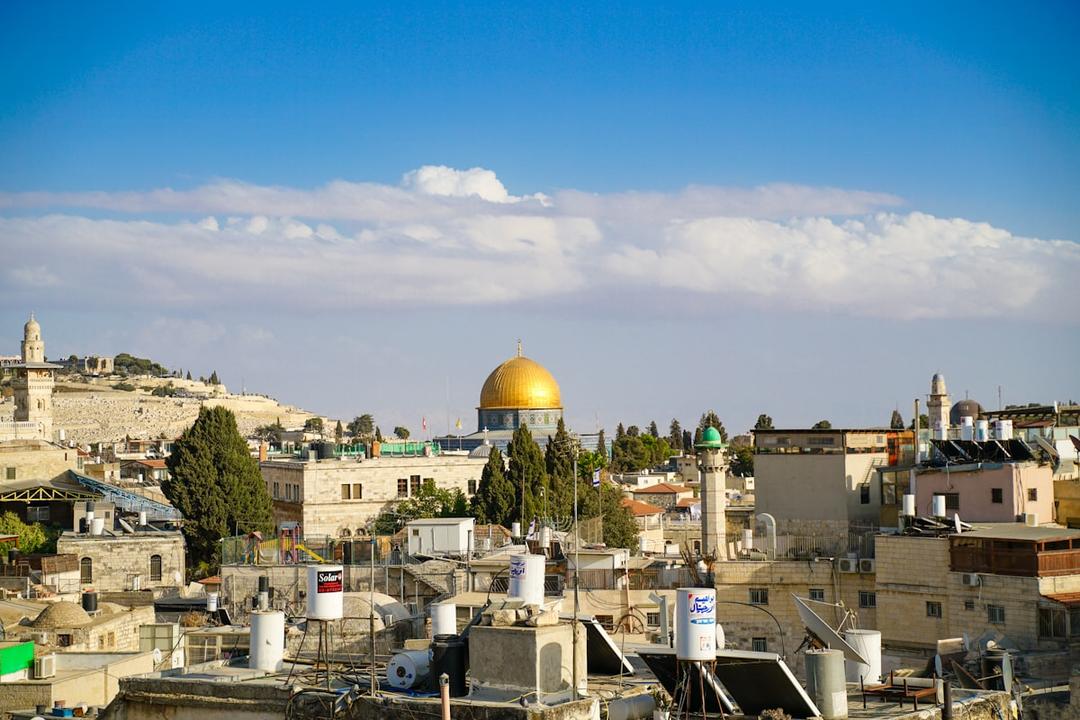
The sacred density of Jerusalem has no parallel anywhere in the world. Within the Old City’s walls — barely one square kilometer — stand the Western Wall, the Church of the Holy Sepulchre, the Dome of the Rock, and Al-Aqsa Mosque. Pilgrims from three faiths walk the same narrow alleyways. They pass sites sacred to traditions not their own with every turn. This layering is not accidental. Each generation built atop the ruins of the last. The result is a vertical archaeology of devotion that reaches down through three thousand years.
What makes Jerusalem unique is not simply that multiple faiths revere it. They revere the same ground for different reasons. The Temple Mount that Jews mourn is the Haram al-Sharif that Muslims celebrate. The stone on which Abraham nearly sacrificed Isaac is the rock from which Muhammad ascended to heaven. This overlap produces both the city’s spiritual energy and its political complexity. Jerusalem belongs to the broader tradition of faith-based pilgrimage that spans all world religions. Yet it stands apart through the sheer concentration of sacred claims pressed onto a single landscape.
Jewish Pilgrimage to Jerusalem
The practice of aliyah leregel — ascending on foot — created one of the ancient world’s most remarkable logistical achievements. Three times a year, during the three pilgrim festivals of Passover, Shavuot, and Sukkot, the roads of ancient Israel filled with families walking toward Jerusalem. They carried offerings and sang the Psalms of Ascent as they climbed toward the Temple. The journey itself was transformative. Pilgrims from remote villages encountered the full diversity of Israelite society on these roads. Archaeological evidence suggests the population of Jerusalem may have tripled during festival periods, requiring elaborate water systems, temporary markets, and ritual purification installations that archaeologists continue to uncover.
The Temple Mount ascent was the culmination of these pilgrimages — the moment when ordinary people entered the presence of God. The rabbis debated the exact route, the purification requirements, the order of sacrifices, all with an attention to detail that reveals how central the physical act of ascending the mountain was to the spiritual experience.
The destruction of the Second Temple in 70 CE transformed Jewish pilgrimage from fulfillment to mourning. Rabbinic literature records pilgrims tearing their garments at the sight of the ruins, a practice that continues at the Western Wall today. Through centuries of diaspora, the prayer “Next year in Jerusalem” kept the pilgrimage impulse alive even when the physical journey was impossible. Rabbi Nachman of Breslov, who made a dangerous wartime journey to the Holy Land in 1798, embodied this unbroken longing — his voyage became one of the most celebrated pilgrimage stories in Jewish tradition.
Christian Pilgrimage to Jerusalem
Helena’s fourth-century journey was more than personal devotion — it was an imperial project that physically shaped the city. Constantine’s building program erected basilicas over the sites Helena identified, creating an architectural template that defined Christian pilgrimage geography for the next seventeen centuries. The Church of the Holy Sepulchre, despite fires, earthquakes, and the competing claims of six Christian denominations that share its custody, remains the gravitational center of Christian sacred geography.
A few decades after Helena, Egeria left the earliest detailed account of a Christian pilgrimage to Jerusalem. Her diary describes the liturgical celebrations at each holy site with remarkable vividness — the processions, the readings, the congregational weeping. Her account reveals a pilgrimage infrastructure already sophisticated enough to guide visitors through a multi-day circuit of sacred sites, each with its own liturgical program tailored to the specific event commemorated there.
The Crusader period (1099-1291) intensified European Christian connection to Jerusalem and established pilgrimage infrastructure — hostels, hospitals, and military orders — that persisted long after the Crusader kingdoms fell. The Knights Hospitaller, originally founded to care for sick pilgrims in Jerusalem, evolved into one of medieval Europe’s most powerful institutions. The Via Dolorosa, the path Jesus is believed to have walked to his crucifixion, became the template for Stations of the Cross in churches worldwide. It offered a way of bringing Jerusalem’s sacred geography to communities that could never make the journey themselves. Today the Via Dolorosa remains the most walked pilgrimage path within the Old City. Franciscan friars lead a procession along it every Friday, a practice unbroken for centuries.
Islamic Pilgrimage to Jerusalem
The significance of Jerusalem in Islamic pilgrimage extends beyond the Isra and Mi’raj — Muhammad’s night journey from Mecca and his ascension through the heavens from the rock now sheltered by the Dome of the Rock. The city served as the first qibla — the direction of prayer — for seventeen months after the Hijra, before the revelation redirected prayer toward Mecca. This temporal priority gave Jerusalem a theological weight that the change of qibla did not erase.
The Umayyad Caliph Abd al-Malik’s construction of the Dome of the Rock in 691 CE was simultaneously an architectural masterpiece and a theological statement about Jerusalem’s continuing centrality. Al-Aqsa Mosque, at the southern end of the Haram al-Sharif, anchors the complex as a site of congregational prayer. Together, the two structures define a sacred precinct that is the third holiest site in Islam after Mecca and Medina.
Medieval Muslim geographers consistently ranked Jerusalem third among the holy cities. The tradition of visiting it — particularly after completing the Hajj — created pilgrimage networks that connected North Africa, Central Asia, and the Indian subcontinent through Jerusalem’s gates. These networks carried scholars, merchants, and pilgrims along routes that shaped Islamic civilization for centuries.
While not part of the obligatory Hajj, Jerusalem is a major destination for ziyarat. Many pilgrims who visit Mecca and Medina extend their journey to include al-Quds. This practice of triangulating Islam’s three holiest cities has deep roots. Fourteenth-century traveler Ibn Battuta included Jerusalem on his legendary journey. Modern pilgrimage packages often combine Hajj or Umrah with a Jerusalem visit, maintaining a connection that is over a thousand years old.
The Old City: One Square Kilometer of Sacred Geography
The Old City’s four quarters — Jewish, Christian, Muslim, and Armenian — impose a grid of cultural distinction onto streets that predate any of these labels. The reality on the ground defies neat boundaries. The Ethiopian monastery sits atop the Church of the Holy Sepulchre. The Western Wall plaza was created in 1967 by demolishing a medieval neighborhood. The Cotton Merchants’ Market connects the Muslim Quarter to the Temple Mount in a passage that has been commercial since the Mamluk period.
For pilgrims navigating this compressed sacred geography, the experience is one of constant transition. The call to prayer from the minarets overlaps with church bells. The scent of frankincense from an Orthodox church mixes with the aroma of Arabic coffee from a vendor two steps away. This sensory density is part of what makes Jerusalem pilgrimage qualitatively different from pilgrimage to any other city: here, the sacred is not separated from daily life but woven through it at every level.
The archaeological depth mirrors the spiritual layering. Beneath the current street level lie Crusader markets, Roman colonnades, Herodian drainage channels, and Iron Age fortifications. Walking through Hezekiah’s Tunnel — a water channel carved in the eighth century BCE to protect the city’s water supply during an Assyrian siege — is to descend through the strata of sacred history. The tunnel is narrow, dark, and knee-deep in flowing water. It is also one of the most powerful encounters with ancient Jerusalem available to modern visitors. The physical experience of wading through Hezekiah’s engineering achievement connects pilgrims to the city’s history in a way that no museum exhibit can match.
Beyond the Walls
Jerusalem’s pilgrimage gravity extends well beyond the Old City into the surrounding hill country. Hebron’s Cave of the Patriarchs, roughly thirty kilometers south, draws both Jewish and Muslim pilgrims to the traditional burial site of Abraham, Isaac, Jacob, and their wives. The site’s dual function — a synagogue and a mosque sharing the same Herodian-era building — mirrors Jerusalem’s own layered sacred geography in miniature.
Rachel’s Tomb near Bethlehem has been a site of prayer for centuries, particularly for women seeking fertility or safe childbirth. Bethlehem itself, the birthplace of Jesus, functions as a satellite pilgrimage destination that most Jerusalem-bound Christian pilgrims visit. The proximity of these sites means that a pilgrimage to the holy city almost always extends outward, creating a web of sacred geography that covers much of the central hill country.
In the Galilee, the mystical traditions centered on Safed drew generations of Jewish pilgrims seeking the teachings of the Kabbalists who settled there in the sixteenth century. Isaac Luria, Moses Cordovero, and Joseph Karo transformed the hilltop town into a center of Jewish mysticism whose influence spread across the entire diaspora. The annual pilgrimage to Mount Meron, where Rabbi Shimon bar Yochai is buried, became one of the largest religious gatherings in the country — hundreds of thousands gather each year on Lag BaOmer. These northern sites function as a secondary pilgrimage circuit that complements Jerusalem’s centrality. They connect the mystical and scholarly dimensions of Jewish sacred geography to the Temple-focused traditions of the capital.
Experiencing Jerusalem Today
Modern Jerusalem receives over three million visitors each year, and the rhythm of pilgrimage remains central to the city’s identity. The Western Wall plaza fills for Shabbat every Friday evening. The Church of the Holy Sepulchre observes a complex liturgical schedule shared among six Christian denominations. The call to prayer from Al-Aqsa echoes across the rooftops five times daily.
The best way to understand Jerusalem is on foot. Walking tours of the Old City’s four quarters reveal connections between sites that no map can convey. The Via Dolorosa passes through a busy market. The sounds of Jewish prayer at the Western Wall mingle with the Muslim call to prayer from the platform above. A Crusader church sits atop a Roman cistern atop a Herodian foundation. Each turn reveals another layer of sacred history pressed against the rhythms of daily commerce and worship.
For those approaching Jerusalem as pilgrims rather than tourists, the city offers something no other place can: sacred geography shared across traditions, compressed into a space small enough to walk in an afternoon but deep enough to study for a lifetime. Our practical planning guide covers the logistics that make or break a Jerusalem pilgrimage — visas, dress codes, access schedules, and the rhythms of Shabbat. If your time is limited, our 3-day itinerary organizes the Old City’s complex access schedule into a day-by-day sequence. For a structured day-by-day approach, the 3-day Jerusalem itinerary sequences the Old City quarters, Mount of Olives, and Bethlehem around access windows that most visitors miss.
Jerusalem shares the characteristic of layered sacred history with Rome, another city where traditions built atop one another, and with Varanasi, where Hindu and Buddhist sacred geography overlap along the Ganges. But no city matches Jerusalem’s density of competing claims per square meter. It is the one place on earth where three monotheistic faiths press their deepest convictions onto the same stones.
Experiences and Tours
Jerusalem’s sacred sites reward guided exploration. A knowledgeable local guide can explain the significance of architectural details that casual visitors walk past. They can navigate the complex access rules that govern sites like the Temple Mount. They can connect the stories behind each stone to the living traditions still practiced there today. The best guides bring Jerusalem’s layered history into focus — showing how a Herodian wall supports a Crusader arch that frames an Ottoman fountain.
Private tours allow pilgrims to focus on the tradition most meaningful to them. Christian-focused tours follow the Via Dolorosa and the churches of the Holy Sepulchre. Jewish heritage tours explore the Western Wall tunnels and the ancient city of David. Multi-faith tours cover all four quarters in a single day. Walking tours are the most rewarding way to experience the Old City, where the streets are too narrow for vehicles and every hundred meters reveals a different century.
Jerusalem Old City Private Tour — Explore Life Then and Now — From $450 · ★ 5.0 (119 reviews) · Private · Free cancellation
Full Day Private Christian Tour in Jerusalem — From $750 · ★ 5.0 (29 reviews) · Private · Free cancellation
Magical Walking Tour in the Old City of Jerusalem — From $100 · ★ 5.0 (27 reviews) · Free cancellation
Explore Jerusalem’s Old City — From $579 · ★ 5.0 (24 reviews) · Private · Free cancellation