4 Days in Rome: A Pilgrim's Complete Itinerary
Day-by-day Rome pilgrimage itinerary — Vatican and St. Peter's, the seven pilgrimage churches, catacombs, and an Assisi day trip.
Four days in Rome lets you move beyond the Vatican and experience the full depth of Christian pilgrimage in the eternal city. This itinerary covers the seven traditional pilgrimage churches established by Saint Philip Neri, the early Christian catacombs, and an Assisi day trip — organized to minimize the backtracking that wastes hours in a city this large.
Review our Rome planning guide for Vatican ticket booking, dress codes, and transport before you arrive.
Day 1: The Vatican
Morning (7:00am – 12:00pm)
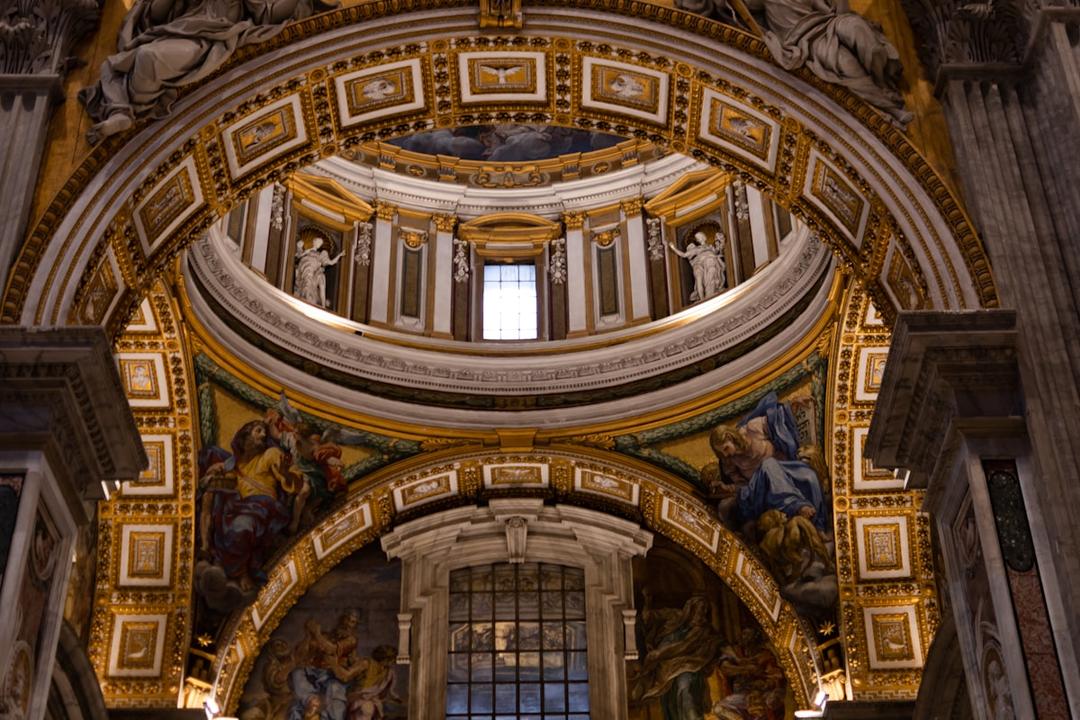
Begin at St. Peter’s Basilica at opening (7:00am). The security line is shortest in the first hour — by 9:00am waits exceed 45 minutes. Enter and spend time at Michelangelo’s Pietà (immediately to the right), the Baldachin over the papal altar, and the crypt below where papal tombs span centuries. The basilica is overwhelming in scale — allow 90 minutes minimum.
After the basilica, climb the dome. The elevator option takes you partway; 320 narrow steps complete the ascent. The view from the top — across St. Peter’s Square, the Tiber, and all of Rome — justifies the climb. Allow 45 minutes roundtrip.
Afternoon (1:00pm – 6:00pm)
Vatican Museums and Sistine Chapel with your pre-booked timed ticket (afternoon slots are less crowded than morning). The galleries contain an overwhelming collection, but pilgrims should prioritize: the Raphael Rooms (especially the School of Athens), the Gallery of Maps, and the Pinacoteca (Vatican painting collection including Caravaggio’s Deposition). All roads lead to the Sistine Chapel — Michelangelo’s ceiling and Last Judgment wall command silence and extended contemplation. Guards enforce a no-photography rule.
Budget 2.5-3 hours for the museums. The route is one-way and covers roughly 7 kilometers of corridor.
Evening
Dinner in the Borgo area near the Vatican, or cross the river to Trastevere — Rome’s most atmospheric neighborhood for evening dining. The church of Santa Maria in Trastevere (one of the oldest churches in Rome, with stunning twelfth-century mosaics) is worth a stop before dinner.
Day 2: The Four Major Basilicas
Today covers four of the seven pilgrimage churches — all major basilicas with deep historical significance. This is the most walking-intensive day, covering roughly 12 kilometers, but Metro connections shorten the distances.
Morning (8:00am – 12:00pm)
Start at St. John Lateran (Metro Line A to San Giovanni). This is the pope’s cathedral — not St. Peter’s — and the oldest of Rome’s four major basilicas. The scale rivals St. Peter’s. The Holy Stairs (Scala Santa) are across the piazza — 28 marble steps that tradition holds were brought from Pilate’s palace in Jerusalem. Pilgrims ascend on their knees. The experience takes 15-20 minutes and is profoundly moving regardless of whether you accept the historical claim.
From the Lateran, walk 15 minutes southeast to Santa Croce in Gerusalemme (pilgrimage church #5). Founded by Empress Helena in the fourth century to house relics from the Holy Land, its chapel of relics contains fragments that tradition identifies as pieces of the True Cross, thorns from the crown, and a nail from the crucifixion. The church is quieter than the major basilicas and rewards unhurried attention.
Afternoon (1:00pm – 5:00pm)
Take the Metro back to Termini and walk 10 minutes to Santa Maria Maggiore (pilgrimage church #3). The fifth-century mosaics in the nave are among the oldest in Rome. The Borghese Chapel contains an icon of the Virgin traditionally attributed to Saint Luke. The basilica’s atmosphere is warmer and more intimate than the Lateran or St. Peter’s.
From Santa Maria Maggiore, walk 15 minutes to San Lorenzo fuori le Mura (pilgrimage church #6), near the Verano Cemetery. This church was heavily damaged by Allied bombing in 1943 and carefully restored. It is the least visited of the seven pilgrimage churches and consequently the most peaceful — a genuine pause in a full day.
Evening
Return to the centro storico for dinner. If energy allows, walk through the Piazza Navona and Pantheon area — the Pantheon was converted to a church in 609 CE and remains one of Rome’s most awe-inspiring spaces.
Day 3: The Southern Churches and the Catacombs
Morning (9:00am – 12:00pm)
Take Metro Line B south to St. Paul Outside the Walls (Basilica San Paolo stop). This basilica marks the traditional burial site of the Apostle Paul. The current building dates to the nineteenth century — the original was destroyed by fire in 1823 — but the scale and atmosphere are magnificent. The cloister is one of Rome’s most beautiful medieval spaces, with spiral mosaic columns that are worth the small entry fee.
From St. Paul’s, take bus 118 or taxi along the Via Appia Antica to San Sebastiano fuori le Mura (pilgrimage church #7). This church sits above one of Rome’s most important catacomb networks.
Afternoon (1:00pm – 5:00pm)
Explore the Catacombs of San Sebastiano (guided tours run every 30 minutes). The underground passages reveal early Christian burial practices, frescoed chapels, and the physical reality of a faith community that built its sacred spaces beneath the earth. Tours last approximately 30 minutes.
Alternatively or additionally, the Catacombs of San Callisto nearby are larger and contain the Crypt of the Popes — burial chambers of third-century pontiffs. The two catacombs are a 10-minute walk apart along the Via Appia.
Walk the Via Appia Antica itself between catacomb sites. The original paving stones, some two thousand years old, survive in many sections. This is the road along which Paul entered Rome as a prisoner — the road that connected the imperial capital to its expanding empire.
Evening
Return to central Rome for your final city evening. The church of San Clemente (near the Colosseum) is an essential stop if time allows — a twelfth-century church built on a fourth-century church built on a first-century Roman house, excavated to reveal all three layers. It is Rome’s pilgrimage in miniature: sacred history stacked on itself, layer beneath layer.
Day 4: Assisi Day Trip
Full Day (7:30am – 7:00pm)
Take the early train from Roma Termini to Assisi (approximately 2 hours, with a change at Foligno). Assisi station is in the valley below the hilltop town — a bus or taxi covers the 4-kilometer ascent.
The Basilica of San Francesco is the primary destination. The Lower Church contains Giotto’s frescoes of the life of Saint Francis — among the most important works of Western art. The atmosphere is dark, incense-scented, and profoundly contemplative. Below the Lower Church, the crypt contains Francis’s tomb, discovered in 1818 after being hidden for centuries.
The Upper Church, severely damaged by earthquake in 1997 and painstakingly restored, contains Giotto’s famous cycle of 28 frescoes depicting Francis’s life. The colors are luminous and the narrative unfolds like a visual Gospel.
After the basilica, walk through the town to the Church of Santa Chiara (Saint Clare) and the Cathedral of San Rufino, where both Francis and Clare were baptized. The walk is gentle and Assisi’s medieval streets are beautiful.
For pilgrims with energy, the Eremo delle Carceri — the hermitage on Monte Subasio where Francis retreated to pray — is a 4-kilometer uphill walk from the town center. The forest path and the tiny caves where Francis and his companions meditated offer a contemplative counterpoint to the grand basilica.
Return train to Rome departs in the late afternoon. The journey back provides time to reflect on four days that have covered nearly two millennia of continuous Christian presence in the Italian peninsula.
Practical Notes
The seven churches circuit is now complete across Days 1-3: St. Peter’s (Day 1), St. John Lateran, Santa Croce, Santa Maria Maggiore, San Lorenzo (Day 2), St. Paul Outside the Walls, San Sebastiano (Day 3). This matches the traditional Philip Neri route spread across a manageable three-day framework. Our seven churches walking guide provides the complete route with distances and Metro shortcuts for each segment.
A Roma Pass (72-hour version) covers unlimited public transport and two museum entries. Purchase it at any Metro station on Day 1.
For the spiritual and historical context behind these sites, explore the history of Christian pilgrimage and the Christian pilgrimage traditions hub page. Rome connects naturally to Jerusalem — where the stories these churches commemorate began — and to Santiago, the third point in the medieval pilgrimage triangle.
Experiences and Tours
Private Tour - City Center — From $138 · ★ 5.0 (163 reviews)
Private Walking Tour of the Squares and Fountains in Rome — From $229 · ★ 5.0 (130 reviews)
The Very Best Tour of Rome — From $842 · ★ 5.0 (95 reviews)
Private Tour: Ancient Rome by Car — From $466 · ★ 5.0 (146 reviews)