Walking the Seven Pilgrimage Churches of Rome
A route guide to Rome's seven pilgrimage basilicas — the Philip Neri circuit with distances, Metro shortcuts, and what to see at each church.
The Seven Churches of Rome pilgrimage dates to the sixteenth century, when Saint Philip Neri organized walking circuits of the city’s most important basilicas as a popular alternative to the excesses of Roman carnival. The route he established covers approximately 20 kilometers and touches nearly two thousand years of Christian sacred history — from St. Peter’s tomb beneath the Vatican to the catacomb churches along the Via Appia.
Walking the full circuit in a single day is possible but demanding. This guide provides the route in sequence with distances, transit options, and the essential details at each church. For Vatican logistics, dress codes, and transport passes, see our Rome planning guide. For a multi-day approach, our 4-day itinerary spreads the churches across three comfortable days.
The Route at a Glance
The traditional sequence, with approximate distances between churches:
- St. Peter’s Basilica (Vatican) — Start
- St. Paul Outside the Walls — 7.5km south
- San Sebastiano fuori le Mura — 4km southeast
- St. John Lateran — 5km north
- Santa Croce in Gerusalemme — 1km east
- San Lorenzo fuori le Mura — 2.5km north
- Santa Maria Maggiore — 2km southwest — End
Total distance: approximately 22 kilometers on foot. Walking time: 5-6 hours of pure walking, plus time inside each church. Full day estimate: 8-10 hours including visits, rest, and a meal.
Church 1: St. Peter’s Basilica
Opens: 7:00am. Arrive by: 7:00am to beat queues.
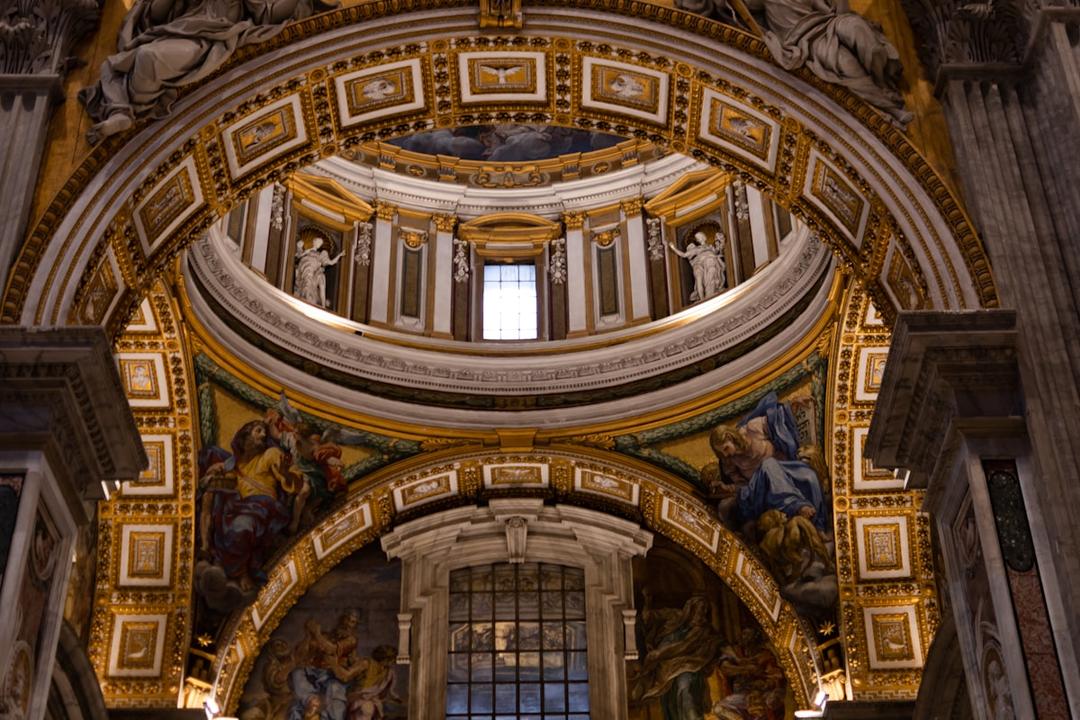
The world’s largest church and the spiritual center of Catholicism. The basilica stands over the traditional tomb of Saint Peter, the apostle Jesus designated as the rock on which his church would be built.
What not to miss: Michelangelo’s Pietà (first chapel on the right), the Baldachin by Bernini over the papal altar, the crypt beneath the altar where papal tombs line a narrow corridor (free entry, accessed from inside the basilica), and the dome — 320 steps after the elevator gets you to the top for a view across all of Rome.
The basilica is free to enter. The dome climb costs approximately €8 (with elevator) or €6 (stairs only). Allow 90 minutes for the basilica and dome combined.
Leaving for Church 2: Exit St. Peter’s Square. Take Metro Line A from Ottaviano to Termini, then Metro Line B to Basilica San Paolo. Total transit: approximately 35 minutes. Alternatively, bus 23 runs directly from the Vatican to St. Paul’s — about 40 minutes.
Church 2: St. Paul Outside the Walls
Opens: 7:00am.
The second of Rome’s four major basilicas, marking the traditional burial site of the Apostle Paul. The current building dates to 1854 after a devastating fire destroyed the fourth-century original. Despite its relative youth, the atmosphere is magnificent — the vast nave is lined with mosaic portraits of every pope in history, and the gilded ceiling reflects light across the marble floor.
What not to miss: the papal portrait medallions circling the nave (tradition holds that when the last empty medallion is filled, the world will end — several are still empty), the cloister (small entry fee, but one of Rome’s most beautiful medieval spaces with spiral mosaic columns), and the Chains of St. Paul relics in the transept.
Allow 45-60 minutes.
Leaving for Church 3: This is the longest stretch without transit. Walk south along Via Ostiense, then east on Via delle Sette Chiese — the original Philip Neri pilgrimage road, named for this very circuit. The walk to San Sebastiano is approximately 4 kilometers (50-60 minutes). Alternatively, bus 714 covers part of the distance.
Church 3: San Sebastiano fuori le Mura
Opens: 8:00am. Closed: 12:00-2:00pm.
The smallest and least visited of the seven churches, and often the most peaceful. The church sits above one of Rome’s most important catacomb networks — the Catacombs of San Sebastiano, which gave the word “catacomb” to the world (from the Greek kata kumbas, “near the hollow”).
What not to miss: the catacombs beneath the church (guided tours every 30 minutes, approximately €10, 30-minute tour showing frescoed burial chambers and early Christian graffiti), the Bust of San Sebastiano by Bernini in the church, and the peaceful garden courtyard.
Allow 45-60 minutes including the catacomb tour.
Leaving for Church 4: Walk north along Via Appia Antica — the ancient road whose original paving stones survive in sections — and turn east toward San Giovanni. The walk is approximately 5 kilometers and takes 60-75 minutes. For faster transit, catch bus 118 from Via Appia to the San Giovanni Metro area.
Church 4: St. John Lateran
Opens: 7:00am.
This is the pope’s cathedral — not St. Peter’s. The Archbasilica of St. John Lateran holds the title “mother and head of all churches of the city and the world.” It was the principal papal residence for nearly a thousand years before the papacy relocated to the Vatican.
What not to miss: the Holy Stairs (Scala Santa) across the piazza — 28 marble steps that tradition holds were brought from Pilate’s palace in Jerusalem. Pilgrims ascend on their knees. The experience takes 15-20 minutes and is available regardless of whether you accept the historical claim. Also see the cloister (entry fee, Cosmatesque mosaic work from the thirteenth century) and the papal altar, which contains a wooden table traditionally identified as the altar on which Peter celebrated the earliest Roman eucharist.
Allow 45-60 minutes.
Leaving for Church 5: Walk east along Viale Carlo Felice. Santa Croce is approximately 1 kilometer — a 15-minute walk.
Church 5: Santa Croce in Gerusalemme
Opens: 7:00am. Closed: 12:30-2:00pm some days.
Founded by Empress Helena in the fourth century to house relics from the Holy Land, this church literally contains Jerusalem soil beneath its floor — brought by Helena from the site of the crucifixion, according to tradition. The name means “Holy Cross in Jerusalem.”
What not to miss: the Chapel of the Relics — a small room behind the altar displaying fragments that tradition identifies as pieces of the True Cross, thorns from the crown, a nail from the crucifixion, and the titulus (the inscription placed above Jesus on the cross). The authenticity of these relics is debated by scholars, but their devotional power is not — pilgrims have venerated them here for seventeen centuries. The chapel is small and often empty. The silence is striking.
Allow 30 minutes.
Leaving for Church 6: Walk north toward Termini station. San Lorenzo is approximately 2.5 kilometers northeast. Walk via Piazza Vittorio Emanuele and Via Tiburtina (35-40 minutes), or take tram 5 or 14 from Porta Maggiore toward the Verano cemetery.
Church 6: San Lorenzo fuori le Mura
Opens: 7:30am. Closed: 12:00-4:00pm.
The least visited of the seven churches and consequently the most contemplative. San Lorenzo was the only Roman church damaged by Allied bombing during World War II — a 1943 raid destroyed much of the thirteenth-century portico. The careful restoration preserved the church’s layered history: a sixth-century basilica joined to a thirteenth-century church, creating an architectural double that you can see in the different floor levels.
What not to miss: the Cosmatesque floor (the geometric marble inlay work characteristic of medieval Roman churches), the tomb of San Lorenzo in the crypt, and the frescoes in the portico depicting the saint’s martyrdom and the 1943 bombing. Pope Pius XII famously visited the bombed neighborhood immediately after the raid — a photograph of him with arms outstretched among the rubble is one of the most iconic images of wartime Rome.
Allow 30 minutes.
Leaving for Church 7: Walk southwest toward Termini. Santa Maria Maggiore is approximately 2 kilometers — 25-30 minutes on foot. Bus 71 also covers the route.
Church 7: Santa Maria Maggiore
Opens: 7:00am.
The largest church in Rome dedicated to the Virgin Mary and the final stop on the seven-church circuit. Legend holds that Pope Liberius built the original church in 358 CE on the spot where snow fell in August — a miracle commemorated each year on August 5 when white flower petals are dropped from the ceiling.
What not to miss: the fifth-century mosaics in the nave — among the oldest in Rome, depicting Old Testament scenes in vivid color. The Borghese Chapel (left transept) contains the Salus Populi Romani icon, traditionally attributed to Saint Luke and one of the most venerated images in Catholic devotion. The coffered ceiling is gilded with the first gold brought from the Americas, a gift from Ferdinand and Isabella of Spain.
Allow 30-45 minutes.
Completing the Circuit
Finishing at Santa Maria Maggiore places you near Termini station — well connected to any part of Rome by Metro, bus, or taxi. The traditional response to completing the seven-church circuit is to give thanks for the grace of the journey and to recognize that the physical walk through Rome’s sacred geography is itself a form of prayer.
Philip Neri understood something that modern pilgrims rediscover on this route: the walk between the churches matters as much as the time inside them. The distance forces a meditative pace. The transitions between sacred spaces and Roman streetlife create a rhythm of encounter and reflection that no church visit in isolation can replicate.
For the theological and historical context that connects these seven churches to the broader history of Christian pilgrimage, and to understand how Rome became one of the three great medieval pilgrimage destinations alongside Jerusalem and Santiago de Compostela, explore our tradition hub on Christian pilgrimage traditions.
Experiences and Tours
Private Tour - City Center — From $138 · ★ 5.0 (163 reviews)
Private Walking Tour of the Squares and Fountains in Rome — From $229 · ★ 5.0 (130 reviews)
The Very Best Tour of Rome — From $842 · ★ 5.0 (95 reviews)
Private Tour: Ancient Rome by Car — From $466 · ★ 5.0 (146 reviews)