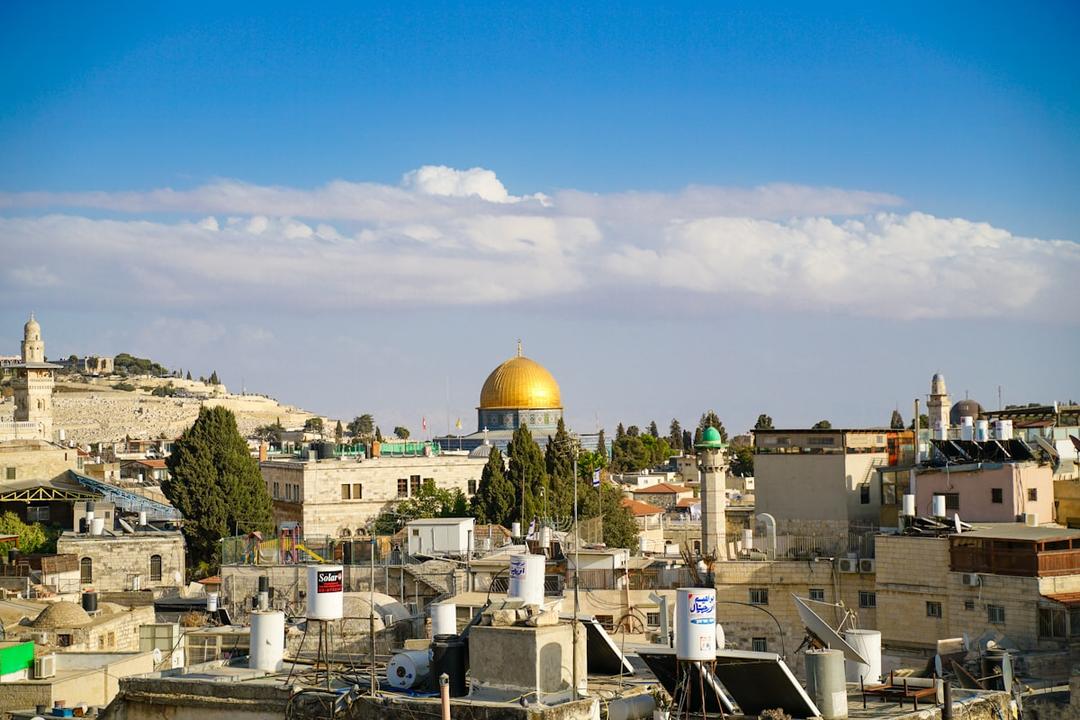
Photo by George 🦅 on Unsplash
The Three Pilgrim Festivals of Judaism
religious context
Understanding the Shalosh Regalim — Passover, Shavuot, and Sukkot — the three annual festivals when ancient Israelites were commanded to appear at the...
Related traditions: Judaism
Regions covered: Middle East
The Biblical Commandment
Three times a year, the Torah commands, “all your males shall appear before the Lord your God in the place that He will choose” (Deuteronomy 16:16). These three occasions — Passover (Pesach), the Festival of Weeks (Shavuot), and the Festival of Booths (Sukkot) — are known collectively as the Shalosh Regalim, the “three pilgrim festivals” or literally “three foot-festivals,” a name that emphasizes the physical act of walking to the central sanctuary. The “place that He will choose” was understood, from the time of King Solomon’s construction of the First Temple around 960 BCE, to be Jerusalem.
The pilgrim festivals represent a distinctive integration of agricultural celebration, historical commemoration, and theological obligation. Each festival marks a stage in the agricultural calendar of the Land of Israel while simultaneously commemorating a foundational event in Israelite history. This dual character — natural and historical, cyclical and linear — gives the festivals a richness of meaning that has sustained their observance across millennia, long after the agricultural dimension became symbolic for urban and diaspora communities.
Passover (Pesach)
Passover, observed beginning on the fifteenth of the Hebrew month of Nisan (typically March or April), commemorates the Exodus from Egypt — the foundational narrative of Israelite identity. The festival’s name refers to God’s “passing over” the houses of the Israelites during the tenth plague, when the firstborn of Egypt were slain. During the Temple period, the central ritual was the sacrifice of the Paschal lamb on the fourteenth of Nisan, followed by its consumption in family groups within Jerusalem on the evening beginning the fifteenth.
The scale of the Passover pilgrimage was enormous. The first-century historian Josephus reported that 255,600 lambs were sacrificed during one Passover — a number that, even if exaggerated, suggests a pilgrim population of well over a million. The logistics of accommodating these numbers in a city of perhaps 80,000 permanent residents required elaborate arrangements: pilgrims camped on the surrounding hillsides, stayed in nearby villages, or were housed by Jerusalem residents who were expected to provide hospitality without charge.
The Passover Seder, the ritual meal that replaced the sacrificial ritual after the Temple’s destruction in 70 CE, preserves the pilgrimage structure in miniaturized, domestic form. The Haggadah text recited at the Seder includes the declaration “Next year in Jerusalem” — a phrase that simultaneously mourns the loss of the Temple pilgrimage and expresses hope for its restoration, keeping the geographical orientation toward Jerusalem alive in diaspora consciousness.
Festival of Weeks (Shavuot)
Shavuot, observed seven weeks after Passover (hence its name), falls in the Hebrew month of Sivan (typically May or June). In its agricultural dimension, Shavuot marks the wheat harvest and the bringing of first fruits (bikkurim) to the Temple. The Mishnah’s description of the first fruits procession provides one of the most vivid pictures of pilgrimage in ancient Jewish literature: delegations from across the country converging on Jerusalem, their wagons decorated with garlands, led by an ox with gilded horns, bringing baskets of fruit to the Temple accompanied by music and singing.
The historical dimension of Shavuot commemorates the revelation at Sinai — the giving of the Torah to Moses and the Israelites. This association, which became dominant in rabbinic Judaism after the Temple’s destruction, transformed Shavuot from an agricultural celebration into a festival of divine communication and covenantal renewal. The custom of studying Torah through the night on Shavuot (Tikkun Leil Shavuot) recreates the experience of vigil and anticipation that tradition associates with the Israelites’ preparation to receive the Torah at Sinai.
Festival of Booths (Sukkot)
Sukkot, beginning on the fifteenth of the Hebrew month of Tishrei (typically September or October), is the most elaborate of the three pilgrim festivals in both its agricultural and liturgical dimensions. The festival commemorates the Israelites’ forty years of wandering in the wilderness after the Exodus, during which they lived in temporary shelters (sukkot). The practice of dwelling in booths — temporary structures with roofs of natural materials through which the sky is visible — translates the historical narrative into embodied experience, as families eat and, in some traditions, sleep in these fragile structures for seven days.
Sukkot during the Temple period featured distinctive rituals of extraordinary sensory richness. The water-drawing ceremony (Simchat Beit HaShoavah) involved a procession from the Pool of Siloam to the Temple, where water was poured on the altar alongside the regular wine libation. The Mishnah records that “whoever has not seen the joy of the water-drawing ceremony has never seen joy in his life” — a statement suggesting that the celebration achieved an intensity of communal festivity unmatched by any other occasion in the Jewish calendar.
The lulav and etrog — a bound bundle of palm, myrtle, and willow branches waved together with a citron fruit — constitute Sukkot’s most distinctive ritual objects. The waving of the four species in all directions symbolizes God’s presence throughout creation, and their combination of different plants has generated extensive allegorical interpretation. During the Temple period, pilgrims carried the four species in procession around the altar, a practice preserved in modified form in synagogue worship today.
The Temple’s Destruction and the Transformation of Pilgrimage
The Roman destruction of the Second Temple in 70 CE shattered the institutional framework of the pilgrim festivals. Without the Temple, the sacrificial rituals that constituted the core of festival observance could not be performed. Without Jerusalem under Jewish sovereignty, the pilgrimage commandment could not be fulfilled in its original sense. The rabbis who reconstructed Judaism after the destruction faced the challenge of preserving the festivals’ meaning while acknowledging that their central practices had become impossible.
The rabbinic solution was twofold: liturgical preservation and eschatological hope. The festival liturgies were adapted for synagogue worship, preserving the language and structure of Temple-era practice in a form that could be performed anywhere. The phrase “because of our sins we were exiled from our land” was incorporated into the festival prayers, maintaining awareness of what had been lost. And the hope for restoration — “Next year in Jerusalem,” “May it be Your will that the Temple be rebuilt speedily in our days” — kept the pilgrimage ideal alive as aspiration even when it could not be realized as practice.
The Western Wall in Jerusalem became the closest accessible point to the Temple’s former site, and visits to the Wall, particularly during the pilgrim festivals, represented a partial fulfillment of the pilgrimage impulse. The practice of ascending to Jerusalem (aliyah la-regel, literally “going up by foot”) during the festivals continues among observant Jews today, though in the absence of the Temple the visit takes the form of prayer at the Western Wall and celebration in the city’s synagogues rather than sacrificial worship.
Aliyah la-Regel — Literally “ascending by foot,” the technical term for pilgrimage to Jerusalem during the three festivals. The term “ascending” reflects Jerusalem’s elevated position in both geography and theology — one always “goes up” to Jerusalem in Hebrew, regardless of one’s starting elevation.
Korban Pesach — The Paschal sacrifice, a yearling lamb or goat slaughtered on the fourteenth of Nisan and consumed in family groups within Jerusalem. The sacrifice’s regulations, detailed in Exodus 12, provided the ritual center of the Passover pilgrimage.
Bikkurim — The first fruits offering brought to the Temple during Shavuot. The ceremony of presentation, described in Deuteronomy 26, required the pilgrim to recite a historical summary beginning “My father was a wandering Aramean” — linking the individual’s agricultural gratitude to the collective narrative of Israelite history.
Sukkah — The temporary booth in which Jews dwell during the seven days of Sukkot. The sukkah’s fragility and impermanence are essential to its symbolism — it represents both the vulnerability of the wilderness wanderings and the trust in divine protection that made survival possible.
Simchat Torah — Celebrated at the conclusion of the Sukkot festival period, this day marks the annual completion and recommencement of the Torah reading cycle. The joyous celebration, involving dancing with Torah scrolls, transforms the intellectual act of study into a physical expression of devotion.
The pilgrimage commandment appears in three Torah passages: Exodus 23:14-17, Exodus 34:22-24, and Deuteronomy 16:1-17. The Mishnah tractate Hagigah elaborates the legal requirements of festival pilgrimage, while tractate Bikkurim describes the first fruits ceremony in detail. Josephus provides external historical documentation in both The Jewish War and Jewish Antiquities. Modern scholarship, particularly the work of S. Safrai and others, has reconstructed the social and economic dimensions of Second Temple pilgrimage using archaeological, literary, and comparative evidence.
- Western Wall — The surviving remnant of the Temple complex and focus of modern Jewish pilgrimage
- Jerusalem Old City — The destination of the pilgrim festivals
- Jewish Pilgrimage Heritage — The broader tradition of Jewish sacred travel
- Rabbi Nachman’s Journey to Israel — A later expression of Jewish pilgrimage longing