Walking Guide to Jerusalem's Old City
A quarter-by-quarter walking guide to Jerusalem's Old City — the Via Dolorosa, Western Wall, Temple Mount access, and hidden corners most visitors miss.
Jerusalem’s Old City packs more sacred history into one square kilometer than any other place on earth. Four quarters, three major faiths, and three thousand years of continuous habitation compressed into a space you can cross in twenty minutes — if you walk fast, which you should not. The Old City rewards slow walking, unexpected turns, and the willingness to get lost in lanes that have channeled pilgrims, merchants, and conquerors since the Bronze Age.
This guide organizes the Old City into walkable sections with practical logistics — opening hours, access restrictions, and the sequence that lets you see the most with the least time wasted in queues. For visa requirements, dress codes, and Shabbat logistics, see our Jerusalem planning guide.
Orientation: The Four Quarters
The Old City divides into four unequal quarters, each with its own character, sounds, and rhythms.
The Muslim Quarter (northeast) is the largest and most densely populated. Its narrow lanes are lined with spice shops, textile merchants, and bakeries. The Via Dolorosa runs through it. The souq along Al-Wad Road is the Old City’s commercial heart.
The Christian Quarter (northwest) centers on the Church of the Holy Sepulchre. Its lanes are quieter than the Muslim Quarter and home to numerous churches, hospices, and religious guesthouses. The Muristan area was the medieval headquarters of the Knights Hospitaller.
The Jewish Quarter (southeast) was largely rebuilt after 1967. Its stone streets are wider and cleaner than the other quarters, with archaeological sites, synagogues, and the Cardo — a reconstructed section of the Roman-era main street. The Western Wall plaza anchors its southern edge.
The Armenian Quarter (southwest) is the smallest and most private. Its population has shrunk to a few hundred residents. The Cathedral of Saint James, rarely open to the public, is one of the Old City’s most beautiful and least visited churches.
Enter through the Jaffa Gate (west) for the easiest orientation — it opens onto the intersection of the Christian and Armenian Quarters with the Jewish Quarter to the south. The Damascus Gate (north) plunges you directly into the Muslim Quarter’s market energy. The Dung Gate (south) is closest to the Western Wall and Temple Mount.
Walk 1: The Via Dolorosa (1.5–2 hours)
Best time: 7:00–9:00am before tour groups arrive, or Friday at 3:00pm when Franciscan friars lead a procession.
Start at Station 1 near the Lions’ Gate (St. Stephen’s Gate) on the Old City’s eastern wall. The Antonia Fortress site — where Pontius Pilate is traditionally believed to have condemned Jesus — is now occupied by the Al-Omariya School. A small chapel marks the station.
Walk westward through 14 stations along a route that follows the traditional path of Jesus carrying the cross to Golgotha. The first nine stations are marked by plaques, chapels, or churches along the streets of the Muslim and Christian Quarters. The route winds through the souq, past spice merchants and fabric shops, creating an unexpected juxtaposition of sacred memory and daily commerce.
Station 5 (where Simon of Cyrene took the cross) has a handprint indentation in the stone wall that pilgrims touch. Station 6 (where Veronica wiped Jesus’s face) is marked by a small chapel of the Little Sisters of Jesus. Station 9 (the third fall) is at the entrance to the Coptic monastery, where a pillar fragment is embedded in the wall.
Stations 10 through 14 are inside the Church of the Holy Sepulchre. Station 10 (stripping of garments) is at the entrance. Station 11 (nailing to the cross) and Station 12 (death on the cross) are in the Chapel of Calvary — climb the steep stairs to the right of the entrance. Station 13 (removal from the cross) is the Stone of Anointing on the ground floor. Station 14 (burial) is the Edicule — the structure enclosing the traditional tomb.
Practical note: the Via Dolorosa is not a straight line. Without a guide or map, you will miss stations, especially 4 through 9 which are tucked into side streets. A guided walk adds enormous value here.
Walk 2: The Jewish Quarter and Western Wall (2–3 hours)
Best time: any morning except Saturday (Shabbat). Friday morning works well — the quarter is active before the afternoon shutdown.
Enter through the Jaffa Gate and walk south through the Armenian Quarter. The transition into the Jewish Quarter is marked by wider streets, cleaner stone, and a modern rebuild that sits on ancient foundations.
The Cardo — the main street of Roman and Byzantine Jerusalem — has been partially excavated and reconstructed. The southern section preserves original column bases and paving stones from the sixth-century Madaba Map mosaic. The northern section is a covered shopping arcade.
The Hurva Synagogue, rebuilt in 2010 after being destroyed in 1948 (and before that in 1720), dominates the quarter’s skyline. Its rooftop offers panoramic views of the Old City, including a direct sightline to the Dome of the Rock.
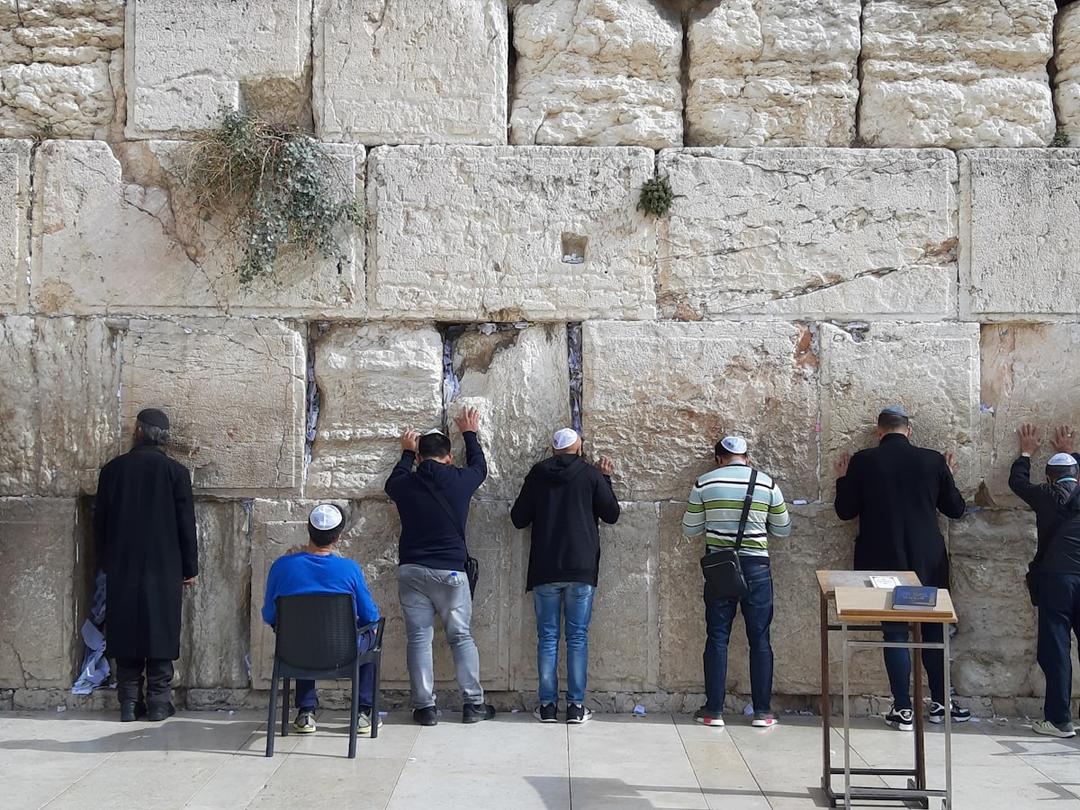
Walk downhill to the Western Wall plaza. The wall is accessible 24 hours and free of charge. Men enter the left prayer section, women the right. Free paper kippot are available at the entrance for men. Spend at least 20 minutes here — the wall’s power is not immediately obvious but builds with stillness.
The Western Wall Tunnels extend along the full 488-meter length of the retaining wall, revealing Herodian stonework invisible from the plaza. Book tickets online in advance — the 75-minute guided tour fills up, especially in peak season.
From the wall, walk south to the City of David — the original Bronze Age settlement just outside the Dung Gate. The highlight is Hezekiah’s Tunnel: a 533-meter underground water channel carved in 701 BCE. You wade through in knee-deep water — bring water shoes. The experience is unforgettable.
Walk 3: The Temple Mount / Haram al-Sharif (1–1.5 hours)
Best time: immediately at opening — Sunday through Thursday, typically 7:30am. Arrive at the Mughrabi Gate by 7:00am.
This is the most time-sensitive walk in Jerusalem. Non-Muslim access is restricted to morning hours only (typically 7:30–11:00am and sometimes 1:30–2:30pm), through the Mughrabi Gate exclusively. Hours change without notice. Confirm the current schedule the evening before at your hotel.
Pass through security — the line moves slowly. Religious items (Bibles, prayer books, visible crosses, Stars of David) are prohibited for non-Muslim visitors. Modest dress is strictly enforced.
Once on the platform, you cannot enter the Dome of the Rock or Al-Aqsa Mosque — both are restricted to Muslim worshippers. But the 35-acre plaza itself is extraordinary. The Dome dominates the center, its gold surface catching morning light. The octagonal structure dates to 691 CE — one of the oldest Islamic buildings in the world.
Walk the full perimeter of the platform. The eastern edge offers views across the Kidron Valley to the Mount of Olives. The southern end approaches Al-Aqsa. The northern edge, near the Gate of the Tribes, is the quietest section and the best place to sit and absorb the site’s atmosphere.
Treat this walk with particular reverence. The platform is among the most contested sacred spaces in the world — holy to Jews as the Temple Mount (site of the First and Second Temples), to Muslims as the Noble Sanctuary (where Muhammad ascended to heaven), and significant to Christians for its associations with Jesus’s ministry. Behaving with respect and restraint here is not just etiquette but a form of pilgrimage in itself.
Walk 4: The Muslim Quarter Souq (1–2 hours)
Best time: mid-morning (9:00–11:00am) when shops are open and energy is high. Avoid Friday midday (prayer time).
Enter through the Damascus Gate — the most dramatic of the Old City’s entrances, with its Ottoman-era facade and the broad staircase descending into the market. The gate itself is worth five minutes of attention: the stonework, the defensive design, the way it frames the narrow lane ahead.
Walk south along Al-Wad Road, the main commercial artery. Spice shops display pyramids of turmeric, sumac, and za’atar. Bakeries sell fresh ka’ak (sesame bread rings). Butchers, fabric merchants, and souvenir shops compete for attention. The sensory density is intense — this is where Jerusalem’s sacred and commercial worlds overlap most vividly.
Turn east onto the Via Dolorosa where it crosses Al-Wad Road. This intersection is the souq’s most chaotic point and its most characteristic — pilgrims carrying crosses pass shoppers carrying groceries.
Detour into the Cotton Merchants’ Market (Suq al-Qattanin), a fourteenth-century Mamluk arcade that is the Old City’s finest example of Islamic commercial architecture. The vaulted stone ceiling, the proportions, and the light filtering through the entries make this one of Jerusalem’s hidden treasures. It leads to a gate onto the Temple Mount (Muslim entry only), but the market itself is open to all.
End at the Austrian Hospice on the Via Dolorosa — a Habsburg-era guesthouse with a rooftop terrace offering one of the best panoramic views in the Old City. The café serves Viennese coffee and apple strudel. The cognitive dissonance of eating strudel above the souq is part of Jerusalem’s charm.
Walk 5: The Mount of Olives Descent (2–3 hours)
Best time: morning, starting by 9:00am. The walk is downhill — begin at the summit viewpoint and descend to the Old City.
Take a taxi to the Mount of Olives viewpoint (the drive takes 10 minutes from the Old City). The panorama from here is the defining image of Jerusalem — the Old City walls, the Dome of the Rock, the Temple Mount, the Kidron Valley below.
Walk downhill through the Jewish cemetery — the oldest continuously used cemetery in the world, with graves spanning three millennia. The path descends steeply through tombstones and olive trees.
Reach the Garden of Gethsemane at the base of the slope. The ancient olive trees — some carbon-dated to nearly 2,000 years — stand in an enclosed garden beside the Church of All Nations (also called the Basilica of the Agony). The church interior is deliberately dark, its ceiling decorated with gold mosaics against deep blue, designed to evoke the night of Jesus’s arrest. The exposed bedrock before the altar is traditionally identified as the place where Jesus prayed.
Adjacent sites include the Tomb of the Virgin Mary (a deep underground church maintained by the Greek Orthodox and Armenian churches), the Church of Mary Magdalene (Russian Orthodox, recognizable by its golden onion domes), and the Dominus Flevit Chapel (a Franciscan chapel shaped like a teardrop, marking where Jesus wept over Jerusalem).
Walk through the Kidron Valley and re-enter the Old City through the Lions’ Gate, which puts you at the beginning of the Via Dolorosa — a natural connection to Walk 1 if you have energy remaining.
Practical Notes
All five walks total approximately 12-15 kilometers over varied terrain. The stone surfaces are uneven and can be slippery when wet. Comfortable walking shoes with good grip are essential.
Carry water at all times — the Old City has limited public water fountains. Sunscreen and a hat are necessary in warm months. A scarf or shawl solves dress code issues at sacred sites.
The walks can be done independently or combined with guided tours. For the Via Dolorosa and Temple Mount especially, a knowledgeable guide adds context that transforms numbered stations into living narrative. See our 3-day itinerary for how to sequence these walks across multiple days.
Experiences and Tours
Best seller! Jerusalem old city four quarters tour — From $450 · ★ 5.0 (148 reviews)
Magical Walking Tour in Old City of Jerusalem — From $100 · ★ 5.0 (27 reviews)
Bethlehem Half Day Private Tour - Pick up from Jerusalem/Tel Aviv/Ashdod — From $350 · ★ 5.0 (55 reviews)
Full Day Jerusalem Tour: In Jesus’ Steps — From $350 · ★ 5.0 (22 reviews)
Full Day Private Christian Tour in Jerusalem with Tour Guide — From $750 · ★ 5.0 (29 reviews)