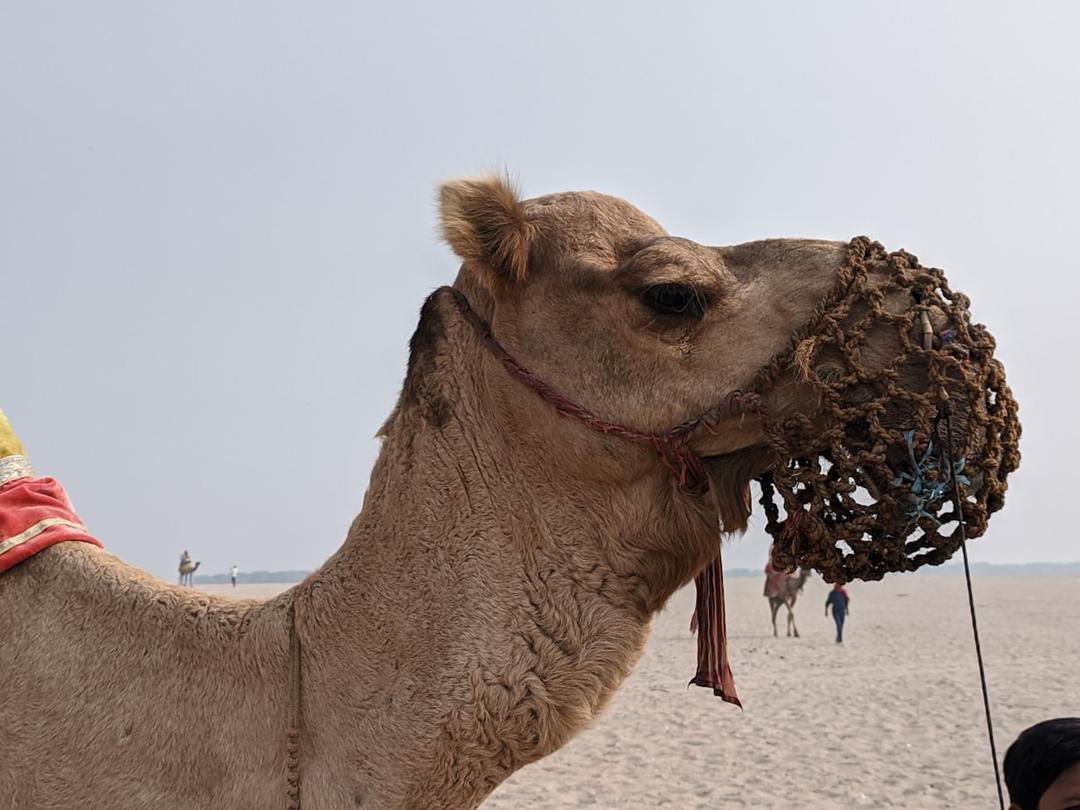
Photo by Hardik Mishra on Unsplash
Varanasi
India's holiest city on the Ganges, sacred to Hinduism, Buddhism, and Jainism for over three millennia.
Associated traditions: Hinduism, Buddhism, Jainism
Varanasi (also known as Banaras or Kashi, “the Luminous One”) claims to be one of the oldest continuously inhabited cities in the world, with settlement evidence stretching back to at least the eleventh century BCE. The city’s location on the western bank of the Ganges, where the river makes a broad northward curve, gives it a cosmological significance in Hindu geography: pilgrimage sites along the Ganges are understood as tirthas—fords or crossing places between the mundane and sacred domains—and Varanasi is the supreme tirtha, the place where the boundary between worlds is thinnest.
Hindu tradition identifies Varanasi as the city of Shiva, where the great deity maintains perpetual presence. The Kashi Vishwanath Temple, dedicated to Shiva as Lord of the Universe, has served as the city’s religious center for at least two millennia, though the current structure dates from 1780, built by the Maratha queen Ahilyabai Holkar after the previous temple was destroyed by the Mughal emperor Aurangzeb in 1669. Aurangzeb constructed a mosque (the Gyanvapi Mosque) immediately adjacent to the temple site, creating a juxtaposition that remains legally and politically contested.
For Buddhism, Varanasi holds significance through its proximity to Sarnath, approximately ten kilometers away, where the Buddha delivered his first sermon. The Buddha himself reportedly visited Varanasi, and the city appears in numerous Jataka tales (stories of the Buddha’s previous lives). Varanasi also holds importance for Jainism: the twenty-third Tirthankara, Parshvanatha, is traditionally believed to have been born here in the eighth century BCE.
Mark Twain, visiting in 1897, wrote that Varanasi was “older than history, older than tradition, older even than legend, and looks twice as old as all of them put together.” While the observation was literary rather than archaeological, it captures something real about the city’s accumulated weight of continuous sacred use—a layering of devotion, destruction, and reconstruction that extends beyond documented history.
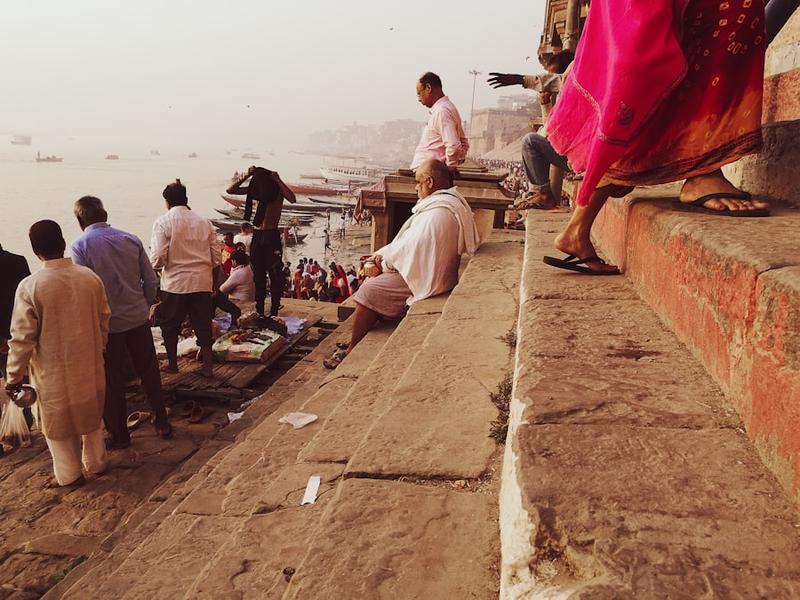
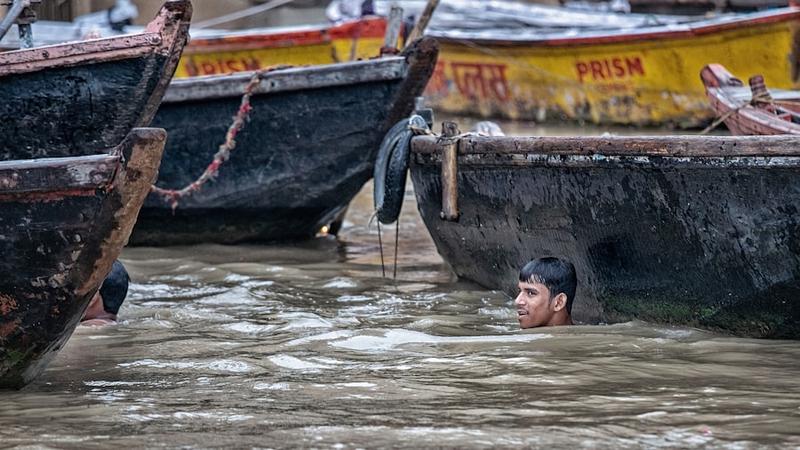
The ghats—broad stone stairways descending to the Ganges along approximately seven kilometers of riverfront—define Varanasi’s sacred geography. Eighty-four ghats serve different functions: bathing, cremation, worship, meditation, and commerce. Each morning at dawn, thousands of worshippers descend the ghats to immerse themselves in the Ganges, performing ablutions understood as purifying both body and soul. The river itself is personified as the goddess Ganga, and contact with her waters is believed to wash away sins accumulated over multiple lifetimes.
Cremation at Varanasi holds unique significance in Hindu belief. Death in Kashi is understood to grant moksha—liberation from the cycle of rebirth—regardless of one’s accumulated karma. This belief makes the city a destination for the dying: families bring terminally ill relatives to die in Varanasi, and the cremation ghats (primarily Manikarnika and Harishchandra) operate continuously, burning approximately 200 to 300 bodies daily. The fires at Manikarnika Ghat are said to have burned without interruption for thousands of years, tended by the Dom caste who hold hereditary rights over the cremation process.
The evening Ganga Aarti ceremony at Dashashwamedh Ghat constitutes one of Hinduism’s most spectacular regular rituals. Priests perform synchronized worship with large fire lamps (deepas), bells, incense, and conch shells as thousands of spectators watch from the ghat steps and from boats on the river. The ceremony, conducted nightly at sunset, draws both pilgrims and tourists, creating a communal experience that bridges devotional practice and cultural performance.
The city’s scholarly tradition is equally ancient. Varanasi has functioned as a center of Hindu learning for millennia, with traditions of Sanskrit grammar, philosophy, music, and textile arts concentrated there. Banaras Hindu University, founded in 1916, continues this tradition. The city’s silk weaving industry, famous for Banarasi saris, represents an artistic tradition intertwined with sacred patronage extending back centuries.
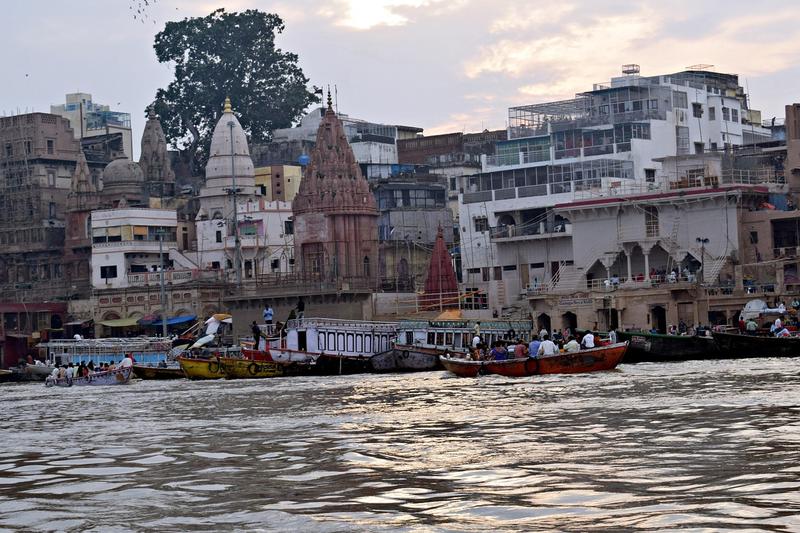
Evening ceremony along the ghats of the sacred Ganges River in Varanasi
Manikarnika Ghat, the primary cremation ghat, presents one of the most confronting sacred spectacles accessible to visitors anywhere in the world. The ghat rises steeply from the river, its steps blackened by centuries of fire. Funeral pyres burn at multiple points simultaneously, tended by male relatives of the deceased and by the Dom workers who manage the cremation process. The open display of death and its rituals embodies the Hindu philosophical teaching that death is not to be feared but understood as transformation—a visible theology enacted in public space.
The Kashi Vishwanath Temple (Golden Temple), rebuilt in the eighteenth century and extensively renovated through the recent Kashi Vishwanath Corridor project (completed 2021), houses one of the twelve jyotirlingas—naturally occurring representations of Shiva considered the most sacred Shiva shrines in India. The temple’s gold-plated spire, donated by the Sikh ruler Ranjit Singh in 1835, gives the temple its popular name. Access for non-Hindus has varied over time; the corridor project has reorganized the approach but maintained restrictions on inner sanctum access.
Sarnath, while technically a separate archaeological site, functions as part of the greater Varanasi pilgrimage . The Dhamekh Stupa, the Ashoka Pillar (whose lion capital became the emblem of the Republic of India), and the ruins of monasteries dating from the third century BCE through the twelfth century CE create an archaeological park of exceptional significance. The Sarnath Museum houses some of the finest examples of Mauryan and Gupta-era sculpture, including the celebrated Lion Capital.
The Ganges itself, while not a “feature” in the architectural sense, is the essential element of Varanasi’s sacred character. The river’s width (approximately 250-400 meters at Varanasi, depending on season), its current, and the quality of light reflecting from its surface create the visual backdrop for all activity on the ghats. Boat trips on the river at dawn, when the ghats come alive with worship, provide the most comprehensive visual experience of the city’s sacred waterfront.
Varanasi is connected by air (Lal Bahadur Shastri Airport, with direct flights from Delhi, Mumbai, and other Indian cities), rail (Varanasi Junction and Varanasi City stations, well-connected to the national network), and road. The city’s internal transportation is chaotic by Western standards—the Old City’s narrow lanes are navigable only on foot or by cycle rickshaw, and the broader streets carry intense traffic.
The dawn boat ride along the ghats is the quintessential Varanasi visitor experience. Boats can be hired at several ghats; early morning departures (around 5:30-6:00 AM) coincide with the busiest worship period. The ride typically proceeds upstream past the principal ghats and returns past the cremation ghats. Negotiating the fare in advance is advisable. The evening Ganga Aarti at Dashashwamedh Ghat begins at sunset; arriving thirty to forty-five minutes early secures good viewing positions on the ghat steps.
Visitors should approach the cremation ghats with respect and sensitivity. Photography at Manikarnika Ghat is prohibited and aggressively enforced. Self-appointed guides at the ghats frequently solicit visitors, and scams involving requests for donations for cremation wood are common. While the cremation ghats are publicly accessible, maintaining appropriate distance and silence respects the families present.
The best visiting season is October through March, when temperatures are moderate (though December and January mornings can be cold and foggy). Summer temperatures exceed forty degrees Celsius, and the monsoon season (July-September) brings heavy rain that can flood lower ghats. The Hindu festivals of Dev Diwali (the gods’ Diwali, usually in November) and Maha Shivaratri (February-March) bring spectacular illuminations and crowds to the ghats.
- Faith-Based Journeys and Pilgrimages — Multi-tradition overview of sacred travel
- Bodh Gaya — The Buddhist sacred site in the same region of India
- History of Christian Pilgrimage — Comparative pilgrimage traditions
- Pilgrimage and Tourism in the Modern Era — The intersection of sacred travel and tourism
This article is part of our guide to Holy India: Varanasi, Bodh Gaya, and the Buddha’s Path. See our Varanasi planning guide for ghat etiquette, temple access, and health tips.
More on Faith-Based Journeys
- Jerusalem — Place
- Santiago de Compostela — Place
- Abraham Path — Route
- Camino de Santiago — Route
- Why Walking to Sacred Places Changes People — Context
- Relics and Sacred Objects — Context
- What Is Pilgrimage and Why Do People Do It? — Context
- Women Who Shaped the History of Pilgrimage — Context